Español
 عربى
 русский
We specialize in network cabling solutions and optical fiber products integrating design, development, sales and service.
Based on the mature research and development system, the quality stability of Simante has been guaranteed at the design source. We have more than 10 engineers and over 30 full-time technical persons who continue to provide their professional value in the position, improving quality and promoting product update.
Simante provides specialized integrated solutions for customers to ensure it meets the customer's requirement. Welcome to visit.
Introduction
The 48 port patch panel exists to solve a simple problem: once a location has more than roughly twenty-five wired connections, managing them across multiple smaller panels starts to add complexity in labeling, rack space, and cable routing. Consolidating those connections into a single 48-port panel keeps the cross-connect point unified and easier to document, without sacrificing the same 110-type termination and T568A/B wiring standard used across smaller panels.
On the front face, ports are typically arranged in a grid of four rows of twelve, each individually numbered, with color-coded groupings on some models to help visually separate zones - for example, one floor or department from another - within the same physical panel.
Rack unit height varies by design: high-density 48-port panels compress the termination blocks tightly enough to fit in a single 1U, which maximizes usable rack space but requires more careful cable dressing during installation, while 2U versions give more physical spacing between termination rows, which many installers find easier to work with, particularly in panels that will see frequent future changes.
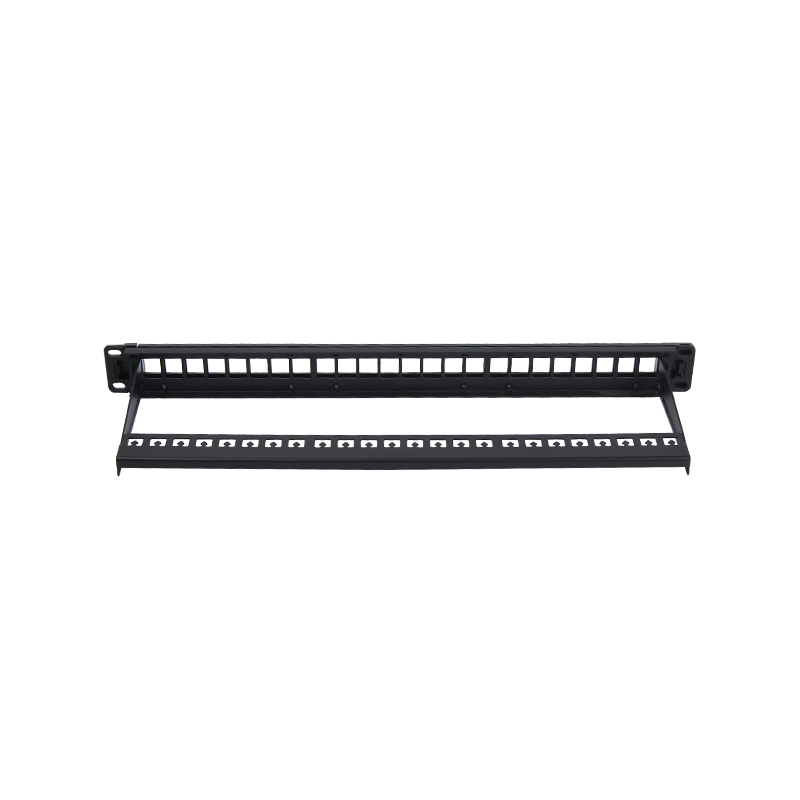
Construction follows the same cold-rolled steel, powder-coated housing used throughout the category, with a rear cable management bar - or in the 2U versions, sometimes a dual-bar design - to handle the larger volume of incoming cable a 48-port panel typically receives.
As with the 24-port version, the panel is available in Cat5e, Cat6, and Cat6A ratings, and mounts to any standard 19-inch rack using its integrated rack ears, requiring only a punch-down tool and standard mounting screws for a complete installation.
Application
A 48 port patch panel is the natural fit anywhere a single wiring closet or rack needs to terminate a large volume of structured cabling - typically sites with somewhere between thirty and fifty active or planned connections, where a single panel is more practical than managing two smaller ones.
Medium and large offices commonly use one or more 48-port panels per floor or per department, consolidating desk drops, conference rooms, printers, and wireless access points into a single cross-connect zone that a facilities or IT team can document and manage as one unit.
Data centers use 48-port copper panels for management networks, out-of-band access, and general connectivity between racks, often stacking several in a single frame to support hundreds of connections across a row without dedicating excessive rack space to termination alone.
Educational campuses, hospitals, and other facilities with high device density per floor - classrooms, patient rooms, nurse stations, badge readers, and security cameras - benefit from the reduced panel count a 48-port layout allows, cutting down on the number of separate zones that need to be tracked in cabling documentation.
Multi-tenant buildings and shared office spaces also make good use of 48-port panels at the main distribution point, where cabling from multiple tenant suites converges before being cross-connected to individual tenant switches or service provider equipment.
For renovation or expansion projects where an existing rack already has several smaller panels reaching capacity, replacing them with fewer 48-port panels is a common way to reclaim rack space for additional switching or server equipment while keeping the same overall port count.
Specification
| Port Count | 48 |
| Category Options | Cat5e / Cat6 / Cat6A |
| Rack Unit Height | 1U (high-density) or 2U (standard spacing) |
| Termination Type | 110-type IDC punch-down |
| Housing Material | Cold-rolled steel, powder-coated |
| Wiring Standard | T568A / T568B color-coded |
| Rack Width | Standard 19-inch |
| Cable Management | Rear management bar (dual-bar on some 2U models) |
| Port Labeling | Numbered with ID label strip |
| Compliance | ANSI/TIA-568-C.2 |
| Color | Black |
Installation, Troubleshooting and FAQ
- Q: When should I choose a 48-port over two 24-port panels?
- A: Once a location's connections pass roughly thirty and are trending higher, a single 48-port panel is usually more space- and cost-efficient than two 24-port panels, and it keeps documentation and labeling in one place rather than split across panels.
- Q: Does a 48-port patch panel need 2U of rack space?
- A: Not necessarily - high-density 48-port models are built to fit a single 1U, while other designs use a more spaced-out 2U layout; either is available, so rack space requirements depend on the specific model chosen.
- Q: Can a 48-port panel handle mixed Cat5e and Cat6 cabling?
- A: Yes, individual ports can be terminated with either cable type on the same physical panel, though each port's actual performance is determined by the cable and patch cord used on that specific run, not by the panel as a whole.
- Q: How do I manage cable congestion behind a 48-port panel?
- A: Use the panel's rear cable management bar to strain-relieve incoming bundles, group cables by row or zone with hook-and-loop ties rather than tight zip ties, and leave a service loop of slack so individual cables can be worked on without disturbing neighboring terminations.
- Q: Is a 48-port patch panel overkill for a home network?
- A: For most home installations, yes - a 24-port panel or smaller usually covers home needs with room to spare, and a 48-port panel is generally reserved for larger offices, campuses, or data center applications with a genuinely higher port count.
- Q: What's the maximum cable run length supported?
- A: As with any Cat5e, Cat6, or Cat6A patch panel, the standard maximum channel length is 100 meters from switch to end device, including the patch cords on both ends, regardless of the panel's port count.
- Q: How long does it take to terminate a full 48-port panel?
- A: Termination speed varies by installer experience, but as a rough guide, an experienced technician can typically punch down and label one port every two to four minutes, putting a full 48-port panel in the range of two to three hours of hands-on termination work.
- Q: Can ports be reassigned later without re-terminating?
- A: Yes - because the permanent cable run stays punched down on the rear of the panel, reassigning which switch or device a connection reaches is just a matter of moving the front-side patch cord to a different switch port, with no re-termination required.