Español
 عربى
 русский
We specialize in network cabling solutions and optical fiber products integrating design, development, sales and service.
Based on the mature research and development system, the quality stability of Simante has been guaranteed at the design source. We have more than 10 engineers and over 30 full-time technical persons who continue to provide their professional value in the position, improving quality and promoting product update.
Simante provides specialized integrated solutions for customers to ensure it meets the customer's requirement. Welcome to visit.
Introduction
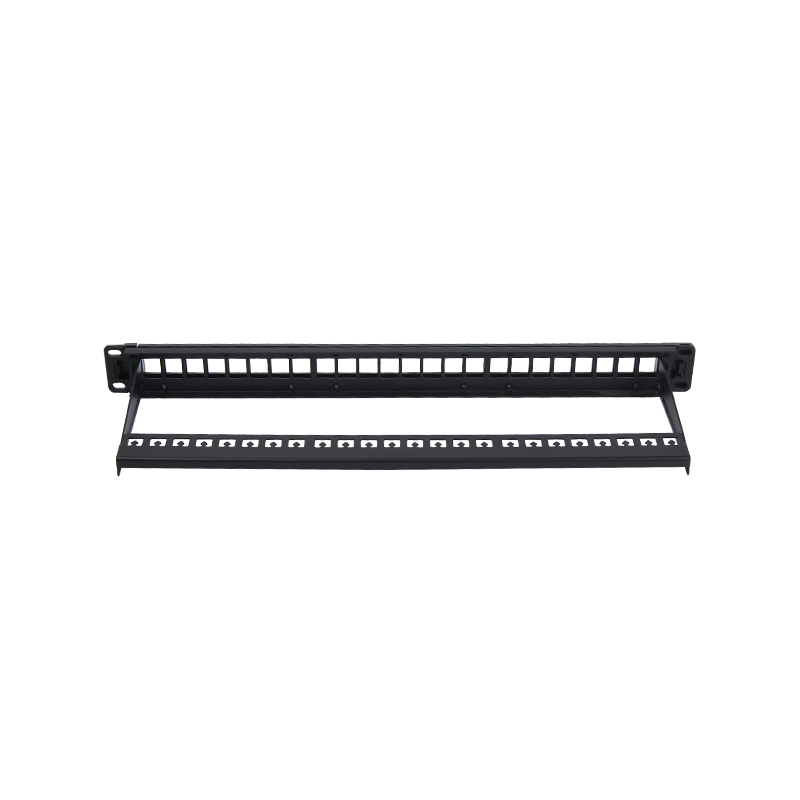
The 24 port patch panel is built around one of the most widely deployed rack unit sizes in structured cabling - a single 1U panel that gives a wiring closet exactly two dozen labeled termination points without consuming more rack space than necessary. It uses the same 110-type IDC punch-down termination found across the broader patch panel category, with each port individually wired according to a printed T568A/T568B diagram.
On the front face, the 24 ports are typically arranged in two rows of twelve, each numbered sequentially and separated into logical groups that make it easy to scan and identify a specific port during troubleshooting. An ID window or label strip above the ports lets installers record which room, jack, or device each port corresponds to.
Housings are stamped from cold-rolled steel with a powder-coat finish, and the rear of the panel includes a cable management bar so that incoming horizontal cable enters under strain relief rather than pulling directly against the termination blocks. This single detail meaningfully extends the working life of the terminations in a busy rack.
Because 24 ports is a common denominator across cabling categories, this panel size is manufactured in Cat5e, Cat6, and Cat6A versions - and in some product lines, unshielded and shielded variants - so the same physical footprint can be matched to the performance level a given project actually requires, from basic office connectivity up to 10-gigabit shielded links.
The panel mounts directly to a standard 19-inch EIA rack frame using its integrated rack ears, requiring only the mounting screws included in the box and a punch-down tool for termination - no specialized installation hardware is needed.
Application
A 24 port patch panel is the default choice for any location with roughly ten to twenty-five wired connections - a category that covers a large share of real-world installations, from single-floor offices to individual classrooms, retail stores, and small branch locations.
In office environments, a single 24-port panel commonly serves one floor of a small business or one department of a larger one, terminating desk drops, a conference room or two, and one or two wireless access points, all within a single rack unit above the switch.
Wall-mount cabinets in network closets, IT rooms, and utility spaces are a particularly strong fit for this panel size, since the shallow depth and 1U height of a 24-port panel fit comfortably in the compact enclosures common to these spaces, unlike deeper, higher-capacity alternatives.
Retail and hospitality locations use 24-port panels for point-of-sale systems, back-office equipment, in-store Wi-Fi, and digital signage, where the total device count per location rarely exceeds two dozen wired drops.
Home network and home-lab builds frequently standardize on a 24-port panel even when the initial cable count is much lower, since the extra capacity comfortably covers future rooms or devices without needing to swap the panel later - a small upfront investment that avoids a larger disruption during a future expansion.
For larger sites, 24-port panels are also used as a modular building block: rather than installing one oversized panel, an installer can add 24-port panels incrementally as each new phase of cabling is completed, keeping each panel's port count matched to a specific zone or project phase for easier documentation.
Specification
| Port Count | 24 |
| Category Options | Cat5e / Cat6 / Cat6A |
| Rack Unit Height | 1U |
| Termination Type | 110-type IDC punch-down |
| Housing Material | Cold-rolled steel, powder-coated |
| Wiring Standard | T568A / T568B color-coded |
| Rack Width | Standard 19-inch |
| Cable Management | Integrated rear management bar |
| Port Labeling | Numbered with ID label strip |
| Compliance | ANSI/TIA-568-C.2 |
| Color | Black |
Installation, Troubleshooting and FAQ
- Q: Is a 24-port patch panel enough for a small office?
- A: For most small offices with fewer than about twenty-five wired connections - desks, a conference room, and a couple of access points - a single 24-port panel comfortably covers current needs with a bit of room for growth.
- Q: What's the difference between a 24-port and 48-port patch panel?
- A: The core difference is simply capacity and rack space: a 24-port panel terminates half as many connections and typically needs only 1U, while a 48-port panel doubles the port count in roughly 1U to 2U depending on the model, which matters most for larger sites or dense equipment rooms.
- Q: What rack unit size does a 24-port patch panel take up?
- A: Almost all 24-port patch panels are built to occupy a single rack unit, or 1U, which is 1.75 inches of vertical rack space.
- Q: Can I use a 24-port patch panel with Cat6a cable?
- A: Only if the panel itself is rated Cat6A; a standard Cat6 panel will physically accept Cat6A cable but will cap the link's performance at Cat6 specifications, so the panel category should match the cable category for full performance.
- Q: How do I know which port corresponds to which wall jack?
- A: During installation, each cable run should be labeled at both ends with a matching identifier, then recorded on the panel's label strip and in a simple cable map or spreadsheet so any technician can trace a port back to its physical location.
- Q: Can a 24-port panel be wall-mounted instead of rack-mounted?
- A: The panel itself still requires a standard 19-inch rack frame to mount into, but that frame can be a small wall-mount rack or open frame designed to attach directly to a wall, which is common in compact IT closets.
- Q: How much does it cost to run a 24-port panel versus individual jacks?
- A: A patch panel adds a modest upfront material cost compared to terminating cable directly into standalone jacks, but it typically pays for itself in reduced labor during future moves, adds, and changes, since reassigning a connection only means moving a patch cord rather than re-terminating cable.
- Q: Do all 24 ports need to be used?
- A: No - it is common and expected for a portion of the panel to sit unused as spare capacity for future drops, and unused ports do not affect the performance of the ports that are actively patched.