Español
 عربى
 русский
Content
- 1 DSL Over Copper Is a Cabling Path, Not Just a Service
- 2 Distance and Pair Quality Set the DSL Over Copper Envelope
- 3 Where DSL Over Copper Still Makes Business Sense
- 4 Selecting Copper Components for DSL Over Copper Projects
- 5 The B2B Sourcing Checklist for DSL Over Copper Cabling
- 6 FAQ: DSL Over Copper in Real Projects
- 7 Related Copper System and Cabling Resources
DSL over copper is often described as a service that simply uses the old telephone line. In practice, it is a transmission path with a budget: pair balance, loop length, joint quality, and noise all decide whether the modem trains at a useful rate or keeps reconnecting. The conclusion is straightforward: if the copper path is planned, labelled, and terminated as part of the building cabling, DSL over copper can be dependable; if it is treated as spare wire, even a healthy ISP signal will produce complaints.
DSL Over Copper Is a Cabling Path, Not Just a Service
DSL, or Digital Subscriber Line, carries data over twisted-pair copper telephone wiring. ADSL and VDSL are familiar variants, and bonded pair designs use more than one copper pair to raise throughput. The modem or DSLAM manages the signal, but it cannot repair a poor physical layer. Loose IDC terminals, corroded joints, untwisted slack, bridge taps, and daisy-chained outlets all add loss and reflection.
For a building owner or integrator, the important boundary is the demarcation point. The service provider may own the line up to that point, but the customer usually owns the cabling after it: riser cable, horizontal cable, faceplates, keystone jacks, patch panels, and patch cords. That is where procurement decisions have a direct effect on service stability. A copper system built for structured cabling is not automatically a DSL system, but a well-installed structured cabling foundation gives DSL over copper a cleaner path and leaves room for Ethernet later.
It also helps to separate DSL from ordinary Ethernet in the planning conversation. Ethernet over twisted-pair uses structured cabling channels with defined category performance. DSL uses the telephone copper plant and is more tolerant of some legacy conditions, but it is also more sensitive to distance and noise in specific ways. Sharing the same cable sheath or pathway is common, yet documentation and separation from power cables still matter. A labelled outlet that is actually a voice extension, not a data point, is a common source of wasted troubleshooting time.
The copper path is part of the service; loose terminations and undocumented bridge taps can degrade DSL over copper even when the ISP signal is healthy.
Distance and Pair Quality Set the DSL Over Copper Envelope
DSL performance falls as loop length increases because higher frequencies attenuate faster on copper. VDSL2 is usually planned on shorter loops than ADSL2+, and bonded pairs can improve throughput only when both pairs are healthy and properly terminated. Gauge, insulation, moisture ingress, and the number of joints all shift the result. A line that tests well at the demarcation point can still disappoint at a far outlet if the internal cabling adds length or imbalance.
The chart below is a qualitative planning aid rather than a field statistic. It ranks the factors that most often appear in DSL stability complaints, so teams can decide where to inspect first and where to spend specification effort.
The most controllable items on that list are termination quality and change control. A technician can replace a damaged patch cord in minutes, but tracing an unlabelled voice extension through a ceiling void can take hours. For that reason, copper system products should be selected as a chain rather than as isolated parts. A CAT6 keystone jack, a matching patch panel, and a factory-made patch cord reduce the number of variables that a DSL technician has to chase.
Simante's copper system is organized around that chain: keystone jacks by category, patch panels for different port counts, faceplates, surface mount boxes, cable managers, and patch cords. The point is not that every DSL project needs premium components. The point is that consistent IDC geometry, plating, and strain relief make the physical layer easier to qualify and easier to maintain after the first service call.
Distance sets the theoretical limit, but termination quality and documentation decide how often a working DSL over copper circuit stays working.
Where DSL Over Copper Still Makes Business Sense
DSL over copper remains useful where the service load is modest and the cable path already exists. Common examples include legacy voice and data services in small offices, remote gateways, lift alarms, access-control panels, building-management controllers, temporary construction sites, retail payment terminals, and backup WAN links. In these cases, the bandwidth requirement is predictable, and the cost of pulling new fiber may not be justified by the application.
It is a poor fit for high-density wireless backbones, multi-camera video systems, data-center links, or any location where the copper run is long, wet, or shared with noisy equipment. The practical rule is to match the service to the load. A DSL line that supports a controller and a payment terminal is a different design problem from a DSL line expected to carry guest Wi-Fi for a busy office. When the load is wrong, support costs rise quickly even if the monthly service charge looks attractive.
Inside the building, DSL over copper often sits beside structured cabling rather than replacing it. A 110 wiring block can organize voice pairs, cable managers can keep patch areas serviceable, and faceplates can give each outlet a clean interface. If the same pathway later needs Ethernet, CAT5E or CAT6 cabling gives the owner an upgrade path without reopening the wall. That mixed approach is common in refurbishment projects where the telephone plant is still in use but the data network is being modernized.
Use DSL over copper where the service matches the load; forcing it into a high-bandwidth backbone creates support costs that outweigh any savings.
Selecting Copper Components for DSL Over Copper Projects
Component selection should start with the physical layer, not the marketing category. A CAT6 jack from one supplier can differ from another in IDC housing, contact plating, pair separation, and cable retention. For DSL over copper, the goal is a balanced, low-loss connection with stable contacts and predictable termination. The table below summarizes the parts that most often affect that outcome.
| Copper element | Why it matters for DSL over copper | Procurement check |
|---|---|---|
| Outside cable and demarcation point | Pair gauge, moisture, and bridge taps affect signal loss and noise. | Ask the service provider for loop qualification and record the cable route. |
| Horizontal cable | Twist integrity, bend radius, and separation from power influence balance. | Verify category, conductor type, jacket material, and installation limits. |
| Keystone jack | IDC termination and contact plating affect insertion loss and long-term stability. | Terminate a sample, inspect pair placement, and check contact retention. |
| Patch panel and 110 block | Termination consistency and labelling make faults easier to isolate. | Check port count, IDC type, label fields, and cable support. |
| Patch cord | Length, plug plating, and strain relief affect signal continuity and wear. | Avoid damaged or mixed cords; confirm category and length before deployment. |
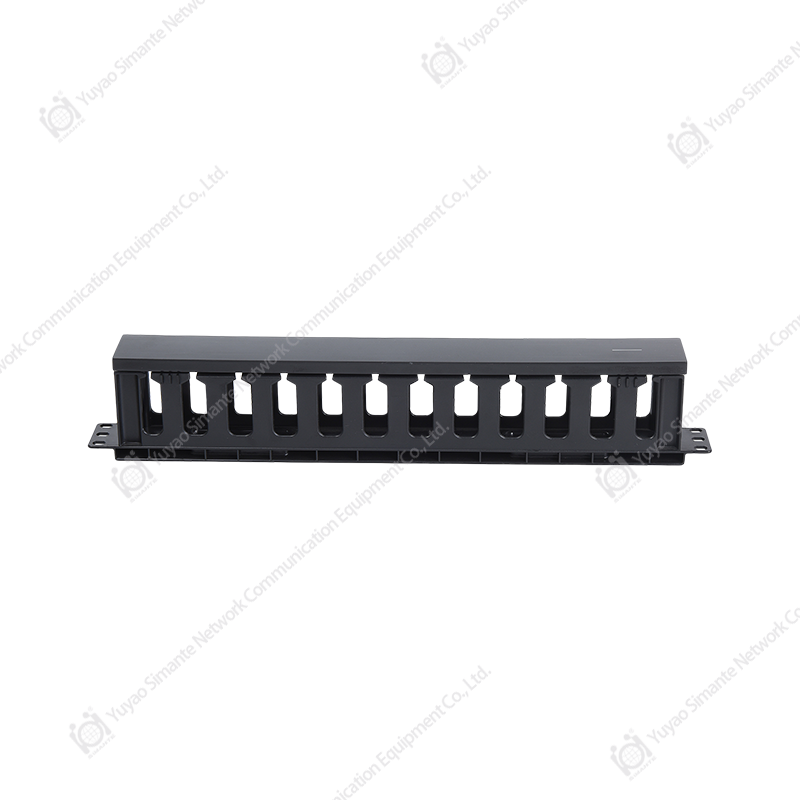
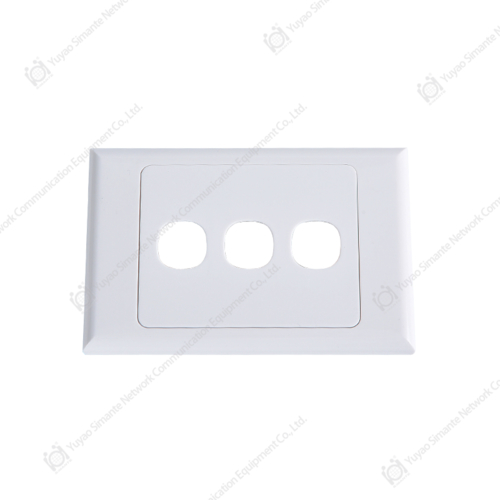
| Faceplate, surface box, and cable manager | Bend radius and service access affect maintenance and accidental damage. | Check fit, material, port configuration, and space for cable routing. |
Category choice deserves a practical note. CAT3 keystone jacks and 110 blocks still have a place in voice-heavy buildings, and DSL over copper can run on legacy telephone wiring. CAT5E and CAT6 components, however, give the owner a cleaner upgrade path and are widely used in mixed voice and data projects. CAT6A and CAT7 are available for higher-performance structured cabling, but they do not automatically improve a DSL circuit if the loop is long or the service provider has not qualified the line.
Shielding is another area where buyers should avoid assumptions. Shielded jacks and patch cords can help in high-interference environments, but the shield must be bonded and grounded correctly. An ungrounded shield can act as an antenna. For most office refurbishments, unshielded twisted-pair components with careful separation from power and good termination practice are easier to control. The project engineer should decide based on the site, not on a catalogue label alone.
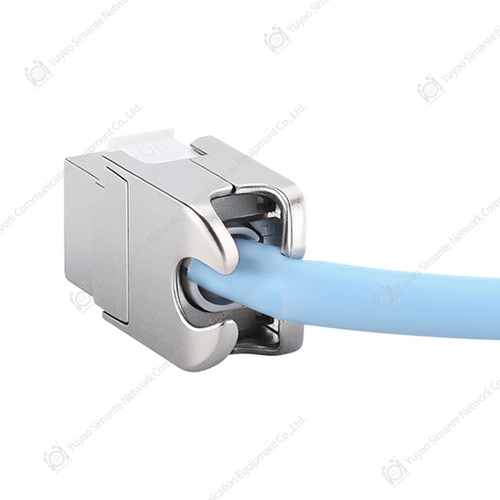
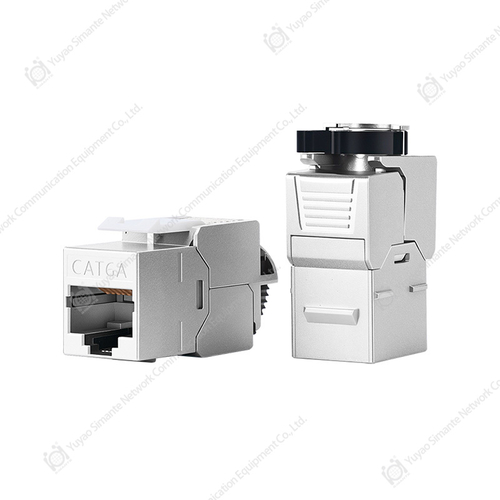
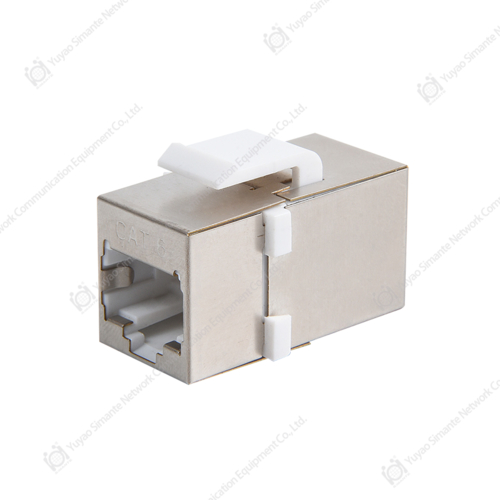 CAT6 Keystone Jacks for Structured Copper CablingCompare shielded, UTP, toolless and angled CAT6 keystone jacks for wall plates, patch panels and surface-mount boxes.View Product →
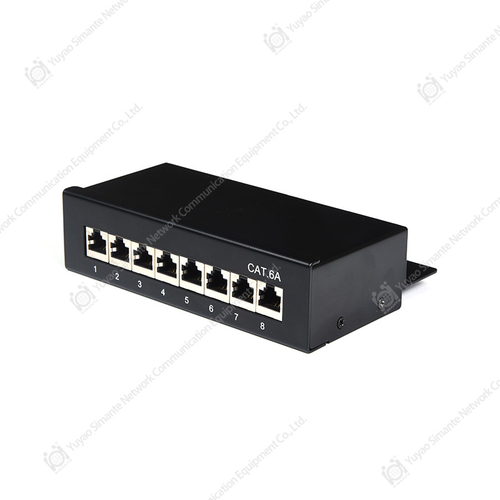
A CAT6 keystone jack is often a sensible middle ground: it supports standard structured cabling needs and gives DSL outlets a repeatable termination point. The same logic applies to patch panels. A 1U 24-port or 48-port panel keeps terminations organized, while blank panels and cable managers make the rack easier to service. For projects that need custom port counts or branding, a manufacturer with in-house tooling and assembly can discuss OEM and private-label requirements without changing the core electrical design.
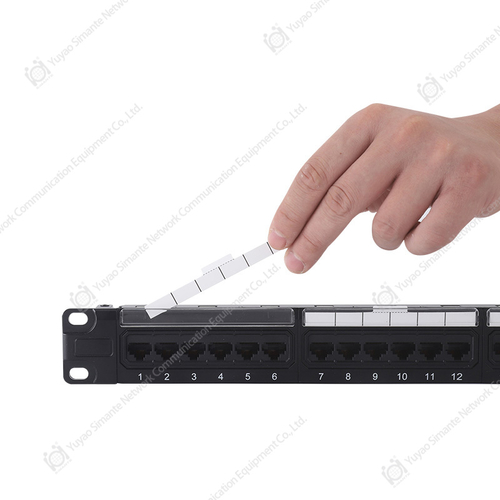 Custom CAT6 Patch Panels for Rack Structured CablingReview 0.5U, 1U and 2U CAT6 panels with 24 or 48 ports, UTP or shielded options and OEM/ODM customization.View Product →
Patch cords are the most frequently touched part of the channel. They are also the easiest to replace with the wrong length, the wrong category, or a damaged plug. In DSL over copper work, keep spare cords labelled by length and category, and remove any cord with a loose latch or bent contacts from service. A factory-made patch cord is generally more consistent than a field-terminated plug, especially when the installation team is working under time pressure.
Buy copper components as a matched channel; the jack, panel, and cord should support the same installation and maintenance routine.
The B2B Sourcing Checklist for DSL Over Copper Cabling
When a project moves from specification to purchase, the supplier relationship matters as much as the part number. A wholesaler may carry several brands, a distributor may focus on fast delivery, and a manufacturer may offer customization and production control. Each can be appropriate. The risk is treating all three as interchangeable when the project needs batch consistency, technical data, or a non-standard faceplate configuration.
For copper cabling, ask for the information that affects repeatability: contact plating, IDC material, cable compatibility, operating temperature, and test reports for the relevant category. Request a sample and terminate it with the cable and tooling that will be used on site. Inspect the pair placement, check that the cable is not over-untwisted, and confirm that the latch or shutter operates without forcing. If the project involves multiple batches, ask how the manufacturer controls colour, moulding, and packaging consistency.
- Confirm the category and construction of each component, not only the product name.
- Ask for test data and material declarations that match the batch being supplied.
- Check whether the supplier can support custom faceplates, labelling, or packaging.
- Verify lead time, minimum order quantity, and spare-part availability.
- Keep a termination sample and a short length of cable for future comparison.
Simante's public profile describes a manufacturer with in-house injection, assembly, and customization lines, serving export markets across many countries. Those capabilities are useful when a project needs consistent faceplate colours, private-label packaging, or a mixed order of keystone jacks, patch panels, and surface boxes. They do not replace project-level testing, but they reduce the chance that the second shipment looks and feels different from the first.
Do not overlook the commercial side of serviceability. A slightly higher unit price for labelled patch panels, spare jacks, and matching faceplates can be cheaper than a site visit caused by a missing part. For DSL over copper, the hidden cost is often not the component itself but the labour required to trace a fault through an unlabelled cabinet. A supplier that can deliver consistent parts and reasonable documentation is worth more than a catalogue with the lowest headline price.
A low-cost reel or jack can cost more than its price difference once a single service call is repeated across a building.
FAQ: DSL Over Copper in Real Projects
Can DSL over copper run on CAT6 cabling?
Yes, DSL can run over CAT6 cabling when the line is correctly terminated and the service provider has qualified the loop. CAT6 does not make a long or noisy line faster by itself, but it gives the installation a balanced twisted-pair path with a practical upgrade route to Ethernet. The important checks are continuity, pair mapping, termination quality, and absence of bridge taps.
Does DSL over copper need a special keystone jack?
No special DSL-only jack is required. A standard CAT3, CAT5E, or CAT6 keystone jack can be used if it is terminated correctly and matches the cable. The better question is whether the jack, patch panel, and patch cord form a consistent channel. Mixed categories and poor IDC work are more common causes of trouble than the absence of a DSL-specific part.
How far can a DSL over copper line reach?
Reach depends on the DSL variant, pair gauge, noise environment, and the condition of the copper plant. ADSL2+ generally tolerates longer loops than VDSL2, while bonded pairs can extend usable service only when both pairs are healthy. Treat any generic distance figure as a planning starting point, then ask the service provider for loop qualification at the actual address.
Should I use shielded or unshielded cabling for DSL over copper?
Unshielded twisted-pair is usually easier to install and maintain in ordinary office spaces. Shielded cabling can be useful near strong electrical interference, but it requires correct bonding and grounding. If the shield is not terminated properly, it may create more problems than it solves. The site survey should decide, not a default preference.
What should a wholesaler verify before buying from a manufacturer?
A wholesaler should verify category performance, contact plating, IDC compatibility, batch consistency, packaging, and lead time. Samples should be terminated with the intended cable and tooling. For custom faceplates or private-label projects, confirm mould ownership, colour matching, and minimum order quantities before the first production run.
The safest procurement rule is to qualify the full copper channel, not just the DSL modem.
Related Copper System and Cabling Resources
For a wider view of the physical layer, start with the copper system overview to see how jacks, panels, faceplates, and cords fit together. If the project combines voice and data outlets, the article on core components of a structured cabling system is a useful companion for planning and labelling.
Plan the copper path as one system, and DSL over copper becomes easier to install, test, and support.