Español
 عربى
عربى русский
Content
- 1 What Is Category 6a Copper Cable?
- 2 Structure and Construction of Cat6a Copper Cable
- 3 Key Performance Characteristics of Cat6a Copper Cable
- 4 Cat6a Copper Cable Compared with Cat5e, Cat6, Cat7 and Cat8
- 5 U/UTP versus Shielded Cat6a: How to Choose
- 6 Common Types and Application Scenarios of Cat6a Copper Cable
- 7 Termination, Installation and Maintenance of Cat6a Copper Cable
- 8 How to Select a Cat6a Cable Manufacturer or Supplier
- 9 Related Reading: Completing the 10G Channel
- 10 Frequently Asked Questions about Category 6a Copper Cable
- 10.1 Is category 6a copper cable faster than Cat6?
- 10.2 Does Cat6a require special connectors?
- 10.3 Can Cat6a copper cable run 10 Gbps at the full 100 meters?
- 10.4 Should I choose U/UTP or shielded Cat6a for an office floor?
- 10.5 Does Cat6a support Power over Ethernet?
- 10.6 Is Cat6a worth the additional cost compared with Cat6?
- 10.7 Can I use category 6a copper cable for smart home wiring?
An installer preparing a 10-gigabit network upgrade needs a cable that will support the link from the moment it is pulled to the decade after the next switch is swapped. Category 6a copper cable has become the default answer for exactly this scenario. It guarantees 10 Gbps across the full 100-meter channel, doubles the bandwidth of standard Cat6, and still terminates on familiar RJ45 hardware. This guide explains what category 6a copper cable is, how it is constructed, how it behaves in real installations, and what should be checked before a bulk purchase from a manufacturer, supplier or wholesaler.
We write from the point of view of a wiring manufacturer that produces keystone jacks, patch panels, patch cords, faceplates and cable management components for copper and fiber structured cabling. That perspective shows up in the practical detail: termination technique, channel testing, component compatibility and the small selection decisions that separate a 10 Gbps link which passes on the first field test from one that keeps the installer coming back to troubleshoot.
What Is Category 6a Copper Cable?
Category 6a, usually written as Cat6a or Cat 6A, is defined in the TIA-568.2-D standard and in ISO/IEC 11801 for enterprise structured cabling. The letter a stands for augmented, because the specification augments the earlier Cat6 standard with much stricter requirements for bandwidth and alien crosstalk. A typical category 6a copper cable contains four twisted pairs of 23 AWG copper conductors, a central separator that holds the pairs apart, and a jacket rated for riser, plenum or low-smoke zero-halogen use depending on the building code.
The two headline figures are 500 MHz bandwidth and 10GBASE-T support over a full 100 m channel. Standard Cat6 is rated for 250 MHz, and although it can run 10 Gbps, it is only certified to do so for 37 to 55 meters in most practical installations. Cat6a removes that distance limit. It also adds defined limits for alien crosstalk, which is interference from neighbouring cables in a bundle, and that condition was the main reason early 10-gigabit copper links were unreliable in dense pathways.
- 500 MHz rated frequency, double the 250 MHz of Cat6.
- 10 Gbps (10GBASE-T) supported over a complete 100 m channel.
- Alien crosstalk limits (ANEXT and AFEXT) defined as part of the standard.
Because Cat6a reaches these numbers with standard RJ45 connectors, it fits into conventional structured cabling systems without proprietary connector systems. That is one of the clearest practical advantages over several other high-bandwidth categories, which require special interfaces or are restricted to short data-center links.
Structure and Construction of Cat6a Copper Cable
Conductors and Insulation
Cat6a cable uses four twisted pairs of copper conductors. Permanent horizontal runs normally use solid 23 AWG conductors, which give better attenuation and mechanical stability than stranded wire. Stranded conductors are reserved for patch cords, where flexibility matters more than the last few decibels of loss. Each conductor is insulated with polyolefin, typically polyethylene or a foamed version. Plenum-rated cables use fluorinated insulation so that they meet fire and smoke requirements inside air-handling spaces, and this choice raises material cost noticeably.
Pair Twists and the Central Separator
What separates Cat6a cable from Cat6 visually is the internal cross separator. The four pairs are twisted around a central spline or star-shaped filler that keeps them at a fixed distance from each other along the whole length. This physical separation reduces crosstalk between pairs inside the cable and gives Cat6a its characteristic round profile. The twist rate of each pair is deliberately different so that interference does not accumulate at the same frequency across all four pairs.
The practical consequence is that Cat6a is thicker, stiffer and heavier than Cat5e or Cat6. A typical Cat6a U/UTP cable is around 0.28 to 0.35 inches in diameter, depending on shielding. That affects conduit fill, bend radius and pulling tension, so pathway planning has to happen before the cable order is placed rather than after.
Shielding Options
| Shielding | Construction | Typical deployment |
|---|---|---|
| U/UTP | Unshielded pairs inside an unshielded jacket. | Office LAN, most horizontal runs with normal separation from power cables. |
| F/UTP | Overall foil screen around unshielded pairs. | General use with improved alien crosstalk margin. |
| S/FTP | Braided outer screen plus foil around each pair. | Industrial plants, high-EMI areas and sensitive data paths. |
Jacket Types and Fire Ratings
Riser-rated cable (CM/CMR) is the most common choice for vertical shafts and floor distribution, while plenum-rated cable (CMP) is required where the cable runs through air-handling spaces. Low-smoke zero-halogen (LSZH) jackets are preferred for public buildings, train stations and hospitals because they release little smoke and no halogens in a fire. Outdoor links need a polyethylene (PE) jacket or gel-filled construction to resist moisture and UV exposure. Each jacket type affects cost, pulling friction and termination stripping effort, so the jacket should be matched to the environment rather than chosen by habit.
Key Performance Characteristics of Cat6a Copper Cable
Category 6a copper cable is not just a thicker version of Cat6. The standard tightens every transmission parameter that matters for 10GBASE-T, and it introduces alien crosstalk limits that Cat6 never had. When a project specifies Cat6a, the installer is buying verified performance at 500 MHz, not simply a larger wire gauge.
| Parameter | What it measures | Why it matters at 10 Gbps |
|---|---|---|
| Bandwidth | Rated frequency range up to 500 MHz. | Higher bandwidth preserves the modulated signal shape used by 10GBASE-T. |
| Characteristic impedance | Nominal 100 ohms across the frequency range. | Mismatch causes reflections, which appear as return loss. |
| Insertion loss | Total signal loss along the cable path. | Long links or marginal connectors consume the link power budget. |
| Return loss | Energy reflected back toward the transmitter. | Poor terminations and kinks create reflections that corrupt data. |
| NEXT and FEXT | Near-end and far-end crosstalk between pairs inside one cable. | 10GBASE-T transmits on all four pairs in both directions, so pair-to-pair isolation is essential. |
| ANEXT and AFEXT | Alien crosstalk from cables in the same bundle. | The main historical limit for 10G at 100 m; Cat6a controls it explicitly. |
| Delay skew | Time difference between the fastest and slowest pair. | Large skew breaks the simultaneous sampling of the four pairs. |
Power over Ethernet is another point of comparison. Cat6a cable with 23 AWG conductors has lower DC resistance than Cat5e, which reduces heat generation. It is well suited to PoE+ and PoE++ installations, where access points, cameras and lighting fixtures draw up to 90 W per port under the latest IEEE 802.3bt Type 4 definition. In large bundles, the heat generated by PoE currents adds up, and the larger conductors of Cat6a give the system more thermal headroom, although bundle size and ambient temperature should still be checked during design.
Cat6a Copper Cable Compared with Cat5e, Cat6, Cat7 and Cat8
Every cabling project reaches a point where the categories must be compared on paper: rated bandwidth, real data rate, supported distance, connector type and installed cost. The table below summarizes the categories that appear most often in building cabling specifications. The differences matter less at 1 Gbps and matter a great deal at 10 Gbps and beyond.
| Parameter | Cat5e | Cat6 | Cat6a | Cat7 | Cat8 |
|---|---|---|---|---|---|
| Rated frequency | 100 MHz | 250 MHz | 500 MHz | 600 MHz | 2000 MHz |
| Typical maximum data rate | 1 Gbps | 1 Gbps, 10G to 55 m | 10 Gbps | 10 Gbps | 25/40 Gbps |
| 10 Gbps over 100 m | No | No | Yes | Yes | Not required at that distance |
| Connector system | RJ45 | RJ45 | RJ45 | RJ45 and some proprietary types | RJ45 or non-RJ45 in high-speed variants |
| Typical shielding | U/UTP | U/UTP or F/UTP | U/UTP to S/FTP | Usually S/FTP | Usually S/FTP |
| Best role | 1G horizontal | 1G horizontal, limited 10G | Universal 10G horizontal | 10G in high-EMI areas | Short data-center links up to 36 m |
| Relative installed cost | Lowest | Low | Medium | Higher | Highest |
Bandwidth is the most direct way to compare twisted-pair categories, because it defines how fast the cable can switch without excessive signal loss. Cat5e was designed for 100 MHz, which comfortably carried 1 gigabit networking in practical installations. Cat6 doubled that to 250 MHz, but only supported 10 Gbps over a limited distance. Cat6a raised the limit to 500 MHz while guaranteeing 10 Gbps over the full 100-meter channel. The chart below compares the rated bandwidth of the major copper cable categories used in structured cabling.
Rated bandwidth of twisted-pair copper cable categories (MHz)
Bar length is scaled for readability. Exact rated frequencies are labeled on each row.
Several conclusions emerge from this comparison. First, the jump from Cat6 to Cat6a is a doubling of bandwidth, and that is exactly what made 10GBASE-T practical across standard 100-meter channels. Second, Cat7 offers only a marginal bandwidth gain over Cat6a, and its additional shielding mainly improves noise margin in specific environments rather than increasing data rate. Third, Cat8 is built for 25G and 40G inside data centers with maximum channel lengths of 30 to 36 meters, so comparing it with Cat6a for general horizontal cabling can be misleading. The chart also explains why Cat6a cable costs more than Cat6: supporting 500 MHz requires larger conductors, tighter twisting, internal separation and stricter manufacturing tolerances. When installers price a project, they see that difference in cable cost, termination cost and testing time. But the value appears when the network moves from 1G to 10G without any change to the cabling. A documented Cat6a installation normally outlasts two generations of active equipment. From a procurement point of view, the comparison affects wholesale pricing and stock planning, because Cat6a cable, jacks and panels must be specified as a matched family rather than as individual parts. In practice, the most relevant comparison for most new projects is Cat6 versus Cat6a, not Cat6a versus Cat7. Once 10 Gbps is a requirement, category 6a copper cable is the most cost-effective twisted-pair category that meets it across the full 100 meters, and that is why it appears so often in modern tender specifications.
U/UTP versus Shielded Cat6a: How to Choose
Within the Cat6a family, the next choice is shielding. U/UTP cable is the most widely installed Cat6a type in office and residential environments. Shielded versions such as F/UTP and S/FTP are preferred where electromagnetic interference is high, where cables run close to power circuits, or where the available routing leaves no space for separation. The two approaches behave differently in termination, grounding and maintenance, so the choice belongs in the design stage rather than at the warehouse.
U/UTP
|
F/UTP or S/FTP
|
A floating shield is worse than no shield. If a shielded cable is terminated with an unshielded jack or the screen is not bonded through the panel and earthing system, the shield becomes an antenna and the link performs worse than an equivalent U/UTP installation. Installers should confirm that every component in the link, including patch cords and faceplates, is compatible with the selected shielding type. For most office environments with proper separation from power cables, U/UTP Cat6a is sufficient. For production halls, hospitals with imaging equipment, or pathways crowded with motor drives and variable-frequency drives, a shielded Cat6a system is the more predictable choice.
Common Types and Application Scenarios of Cat6a Copper Cable
Cat6a cable is sold in several configurations, and each one suits a different part of a building network. The quick reference below shows the most common types found in a structured cabling project. The card sequence runs from the most frequently used indoor types to outdoor and shielded variants.
Solid U/UTP Riser
Permanent horizontal runs in floors, shafts and ceilings. The standard choice for most office and campus installations.
Plenum CMP
Fire-rated jacket for air-handling spaces with low smoke and flame spread requirements.
LSZH
Low-smoke zero-halogen jacket for public buildings, transit stations and high-occupancy areas.
F/UTP
Overall foil screen improves alien crosstalk margin with a moderate cost increase.
S/FTP
Braided screen plus foiled pairs for maximum protection in industrial and high-EMI environments.
Outdoor PE
Polyethylene jacket and gel-filled core for aerial, duct or direct-burial segments between buildings.
Data Centers and Server Rooms
In data-center racks, Cat6a copper cable is commonly used for top-of-rack switch to server links, storage connections and management planes where 10 Gbps is required and optical modules are not justified by distance. The cable is terminated on high-density patch panels in distribution areas and on server-facing outlets. Panel density, rear cable support and label accuracy decide how easy the installation is to maintain later.
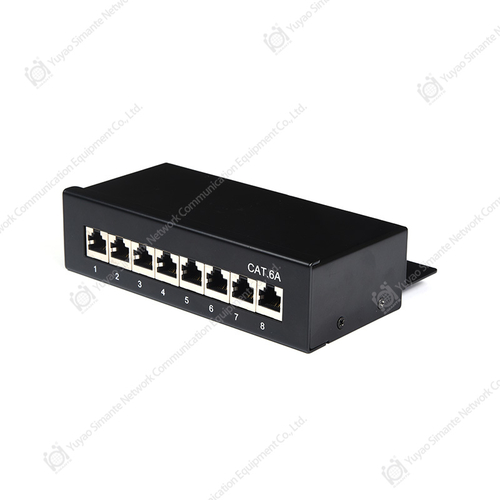 Cat6A Shielded and UTP Patch Panels for Data Center and Office CablingThis product range includes 8-, 12-, and 24-port shielded and unshielded Cat6A patch panels with 90- or 180-degree styles. They suit high-density rack termination where 10 Gbps links and PoE+ delivery must remain reliable and easy to maintain.View Product →
Enterprise Office Networks
For horizontal cabling to workstations, IP phones and Wi-Fi access points, Cat6a provides a balanced combination of bandwidth, PoE delivery and future-headroom. A typical office floor runs solid U/UTP Cat6a from the floor distributor to a Cat6a keystone jack behind each desk, with patch cords completing the channel. This layout supports simultaneous gigabit data, PoE+ power and the next upgrade to 10 Gbps without new cable pulls.
Smart Buildings, Healthcare and Education
Smart-building networks now carry lighting control, security cameras, access control and HVAC sensors over the same cabling as data. PoE++ links draw more current, and the 23 AWG copper in Cat6a keeps voltage drop and heating under control. In hospitals, LSZH jackets limit smoke and toxicity in a fire. In schools and universities, the long design life of Cat6a avoids re-cabling during building renovation cycles.
Industrial and Outdoor Links
Production floors and inter-building links are the most demanding environments. Shielded Cat6a (F/UTP or S/FTP) rejects interference from motors and frequency drives, while outdoor-rated PE jackets resist moisture and sunlight. For segments that pass through buried conduits, gel-filled and water-blocked constructions prevent water ingress from degrading the pairs over time.
Termination, Installation and Maintenance of Cat6a Copper Cable
Termination with Keystone Jacks and Panels
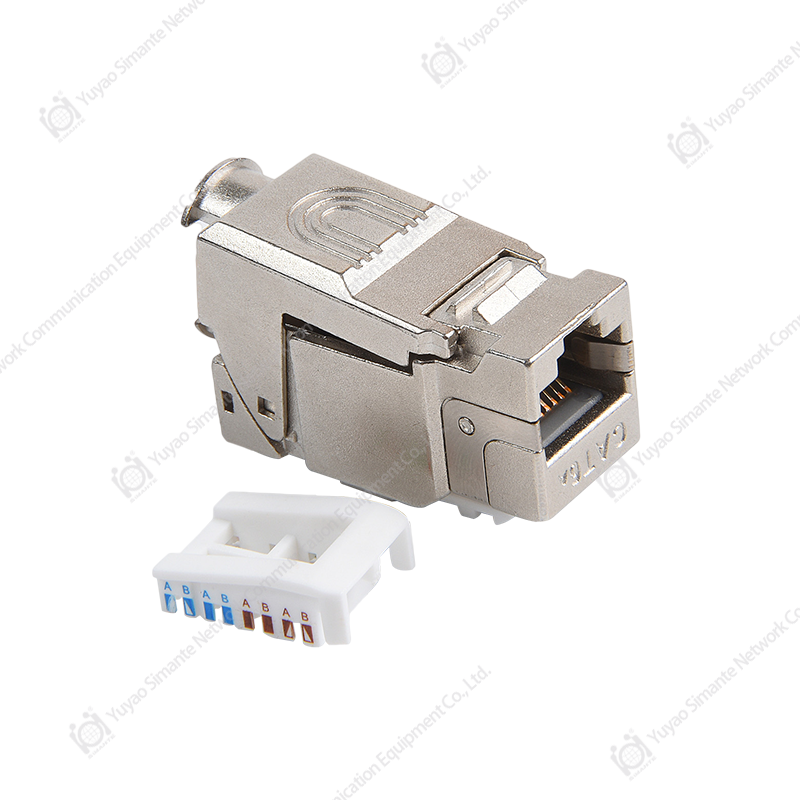
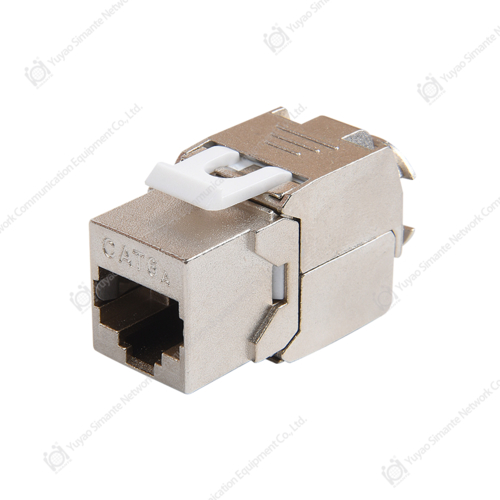
A 500 MHz channel is only as precise as its termination. The most common termination point is a keystone jack mounted in a faceplate or patch panel. Cat6a jacks use either a punch-down block or a toolless cap that pushes the conductors into insulation-displacement contacts. The wiring order must follow T568A or T568B consistently for both ends, and the pair twists should be kept as close to the jack as possible. Untwisting more than roughly 13 mm destroys the crosstalk balance that the cable was built to deliver.
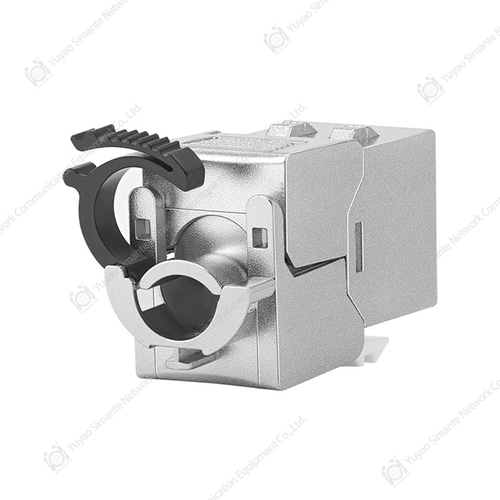
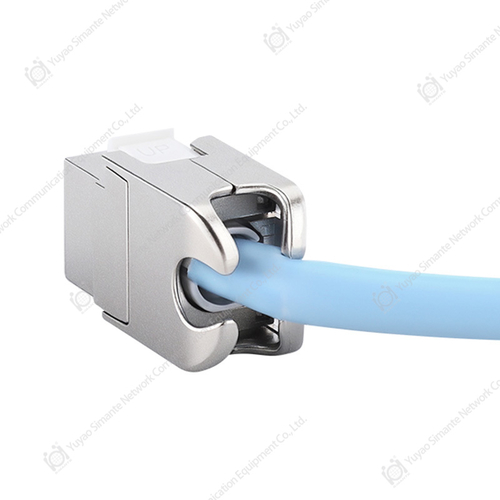
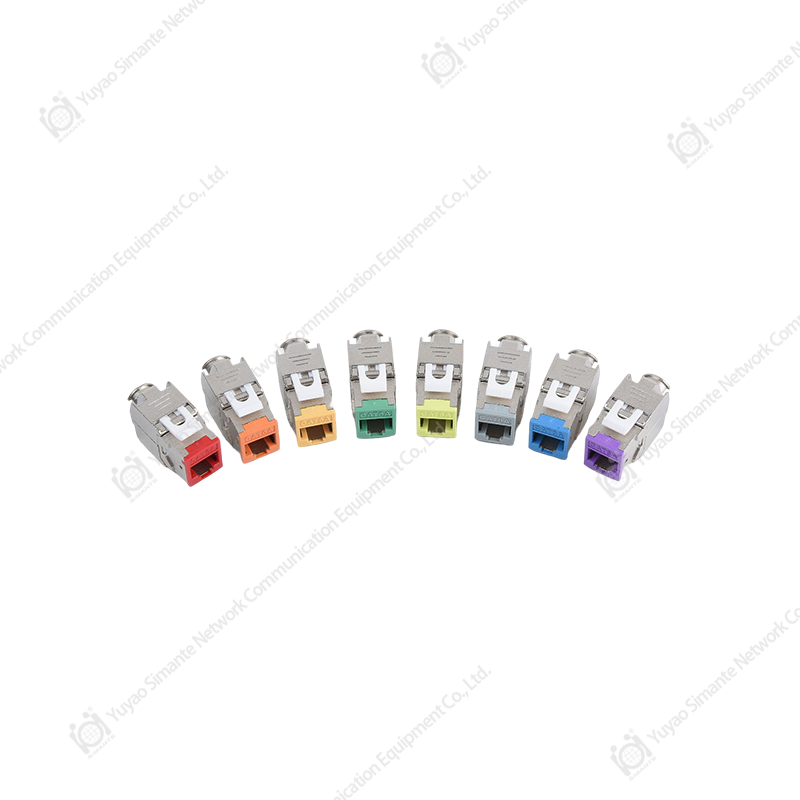 Shielded Cat6A Toolless Keystone Jacks with Varied Entry AnglesThese toolless keystone jacks support shielded Cat6A termination in faceplates and patch panels. Options include 180-degree, 45-degree entry, and ratchet-lock designs, helping preserve pair twists and crosstalk balance for certified 500 MHz channels.View Product →
Field-terminable RJ45 plugs exist for Cat6a and are useful for short direct connections from a wall outlet to a camera or an access point. The plug must be rated for the cable construction, and the pair twists must be preserved inside the plug body. Terminating stranded patch-cord cable with a plug designed for solid cable is a common source of intermittent failures, so the plug package should always state which conductor type it accepts.
Installation Practice
Cat6a cable is less forgiving than Cat5e during pulling. The recommended bend radius is around four times the outer diameter, and the pulling tension should stay below the manufacturer limit, typically 25 pounds for a four-pair cable. Kinks and pinch points damage the separator and change the pair geometry permanently; a kinked cable section cannot be completely restored by straightening. In large bundles, the compacted cable mass can also increase alien crosstalk, so design documents should limit bundle size or allow separation between bundles in the pathway.
Testing the Installed Channel
After termination, each link should be verified with a field certifier, not simply checked for continuity. The installer needs permanent-link test data for building handover and channel test data for the complete path including patch cords. Key criteria are insertion loss, return loss, NEXT, FEXT and alien crosstalk against the Cat6a limits. A certifier that reports headroom for each parameter gives the owner confidence that the channel will pass again after moves and changes.
Maintenance and Lifecycle Care
Cat6a systems reward tidy cable management. Horizontal cable managers, structured patch cords and clear labels make future adds, moves and changes faster and less risky. During maintenance, technicians should avoid over-tightening cable bundles, because the fastening can crush the jacket and deform the pairs. When equipment changes, only the patch cords at the ends should be replaced; the permanent link is designed to remain in place for the life of the building. Periodic re-testing of representative links is good practice in environments where ports are changed frequently, such as data centers and laboratories.
How to Select a Cat6a Cable Manufacturer or Supplier
For wholesalers, cabling contractors and system integrators, buying category 6a copper cable is a repeatable procurement decision, and the supplier matters as much as the price per box. A dependable manufacturer should be able to demonstrate standards compliance, production consistency and the ability to supply matched components for the complete channel.
Standards Compliance and Test Evidence
Request a test report for the specific product you plan to order. A serious manufacturer verifies insertion loss, return loss, NEXT, FEXT, delay skew and alien crosstalk on production samples, not only in the design phase. Certificates should reference the relevant TIA or ISO/IEC requirements. If a supplier can only provide a generic datasheet without test data, the risk shifts to the installer.
Matched Component Families
A 500 MHz channel is only as strong as its weakest component. Mixing a Cat6a cable with a Cat5e-rated jack often produces a link that fails certification near the 500 MHz limit. A factory that produces the cable, keystone jack, patch panel and patch cord as a coordinated family makes the procurement simpler and reduces the chance of mismatch. Our copper system covers Cat3 to Cat7 jacks, patch panels, faceplates and patch cords, so the entire channel can be sourced from one production line.
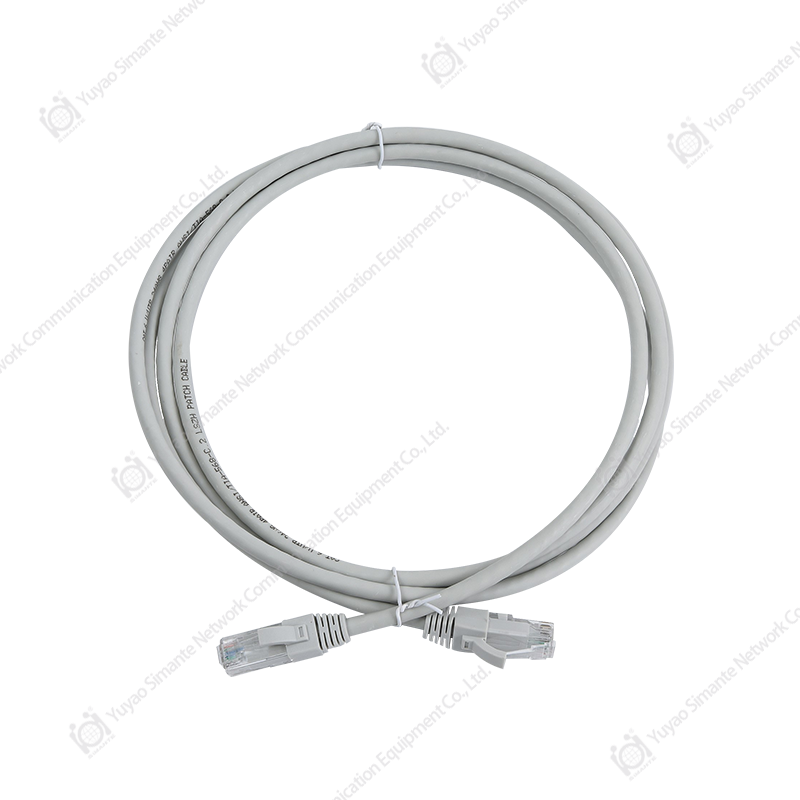 Cat6A and Cat8 Patch Cords with OEM Customization OptionsThis manufacturer provides Cat6A UTP and S/FTP patch cords plus Cat8 flat cables, with custom lengths, colors, labels, and private packaging. Coordinating patch cords with jacks and panels from the same factory simplifies channel consistency for professional projects.View Product →
Customization and OEM Support
Most professional Cat6a projects need non-standard lengths, color-coded jackets, custom labels or private-brand packaging. A manufacturer with flexible production lines can deliver these requirements without inflating lead times. Buyers should confirm the minimum order quantity, available jacket colors and the turnaround time for custom printing before placing the first order.
Export Experience and Logistics
International buyers benefit from a supplier that understands export packaging, container loading and documentation. Factories that ship regularly to 45 or more countries usually have stable carton designs, label formats and quality records that simplify customs clearance. For repeated wholesale orders, the supplier should also maintain stock of popular configurations so that urgent projects do not depend entirely on production lead time.
It is also worth reviewing the manufacturer background before committing. A company that publishes its factory history, equipment and quality approach is easier to evaluate than one that only presents a product list. You can read about our production capability and company profile on the about page of this site.
Related Reading: Completing the 10G Channel
A full 10-gigabit copper channel is a system, not a single cable. The connection points, patch panels and cable managers around the cable determine how well the link performs and how easy it is to maintain over its service life. The following guide explains the role of each element in a structured cabling system and is written by the same team that builds the components.
Core components of a structured cabling systemExplains how keystone jacks, patch panels, patch cords, faceplates and cable managers work together as one channel, and how each component affects certification and long-term reliability. |
Frequently Asked Questions about Category 6a Copper Cable
Is category 6a copper cable faster than Cat6?At 1 Gbps, the two categories perform identically for most users. The difference appears at 10 Gbps: Cat6a supports 10GBASE-T over the full 100-meter channel, while Cat6 is only certified for 37 to 55 meters. Cat6a also provides more design margin at high data rates and higher PoE loads, so it is the safer choice for buildings with a long expected service life. |
Does Cat6a require special connectors?Cat6a uses standard RJ45 connectors, keystone jacks and patch panels, so no proprietary interface is needed. However, the connectors must be rated for Cat6a performance. A Cat6a-rated jack has stricter internal geometry and crosstalk isolation than a Cat5e or Cat6 jack, and using lower-rated connectors will compromise the 500 MHz performance of the channel. |
Can Cat6a copper cable run 10 Gbps at the full 100 meters?Yes, provided the entire channel meets the Cat6a specification. The channel includes the cable, two keystone jacks or connectors, and the patch cords in use. The full link must be tested with a certifier that measures the Cat6a parameters against the 100-meter channel limit. A permanent-link test alone is not sufficient proof for the complete installed path. |
Should I choose U/UTP or shielded Cat6a for an office floor?For most office and residential environments where power cables are separated from data paths, U/UTP Cat6a is sufficient, simpler to terminate and less expensive. Choose F/UTP or S/FTP when the routing passes near motors, drives, transformers or other strong EMI sources, or when the building owner requires the extra alien crosstalk margin. If you select shielded cable, confirm that jacks, panels and patch cords are all shielded and that the shield path is grounded correctly. |
Does Cat6a support Power over Ethernet?Yes. Cat6a cable with 23 AWG conductors has lower DC resistance than Cat5e, which reduces heat generation and voltage drop. It supports PoE, PoE+ and the higher-power PoE++ types defined in IEEE 802.3bt, including the 90 W per port configuration. In large bundles, ambient temperature and bundle fill should still be checked, because heat from multiple PoE circuits can accumulate. |
Is Cat6a worth the additional cost compared with Cat6?The cable itself costs noticeably more than Cat6, and termination and testing time also increase. The comparison changes when you factor in building life. If the network will move to 10 Gbps within the next five to eight years, the extra cost of Cat6a is small compared with the cost of replacing Cat6 in finished walls and ceilings. For short-term projects with no 10G plan, Cat6 remains an acceptable budget option. |
Can I use category 6a copper cable for smart home wiring?Yes. Smart homes benefit from Cat6a because the number of runs is small and the cost difference between Cat6 and Cat6a is limited. The cable supports high-bandwidth applications, PoE cameras, access points and future 10G devices without rewiring. An LSZH jacket is recommended for indoor residential paths, and U/UTP construction is normally sufficient unless the cable runs close to power circuits. |
Category 6a copper cable solves a real engineering problem. Ten-gigabit links now travel to desks, cameras, access points and industrial controllers over standard RJ45 channels, and they do so reliably because the Cat6a standard addresses the interference mechanisms that earlier categories ignored. The cable demands more care in design, termination and testing than Cat5e or Cat6, but it is a mature, standards-backed solution with a service life that typically outlasts two generations of active equipment.
From a buying perspective, the practical steps are simple: verify the test reports, match the jacks and panels to the cable, select the right shielding and jacket for the environment, and test every installed channel before handover. A clean Cat6a installation is quiet, fast and durable, and it removes the uncertainty from the next network upgrade.