Español
 عربى
عربى русский
Content
- 1 What Bare Copper Ethernet Cable Actually Means
- 2 Why Conductor Choice Changes Real Project Outcomes
- 3 Comparing DC Resistance Across Conductor Constructions
- 4 CAT5e, Cat6, Cat6a and Cat7 in Genuine Bare Copper
- 5 Solid Versus Stranded Bare Copper, and Where Each Belongs
- 6 Shielding Options Around a Bare Copper Core
- 7 Application Scenarios and Selection Points
- 8 How to Verify Bare Copper Before You Accept a Shipment
- 9 Buying in Bulk from a Manufacturer, Not a Reseller
- 10 Installation and Maintenance Practices That Protect the Copper
- 11 Common Failure Modes and How to Diagnose Them
- 12 Frequently Asked Questions About Bare Copper Ethernet Cable
- 12.1 Is bare copper ethernet cable better than copper-clad aluminium?
- 12.2 How can I tell whether a cable is really bare copper?
- 12.3 Does bare copper ethernet cable support Power over Ethernet?
- 12.4 What is the difference between bare copper and tinned copper?
- 12.5 Can I mix Cat6 and Cat6a components in one channel?
- 12.6 What gauge should I choose for a long PoE run?
- 12.7 How do I check the length of a reel I have received?
- 12.8 Is Cat7 necessary if I already use Cat6a?
- 12.9 What should I test on arrival for a bulk order?
- 12.10 How long does bare copper ethernet cable last?
- 12.11 Do you supply bare copper ethernet cable for wholesale and OEM programmes?
- 13 Where to Go Next
Two quotes land on the same desk for the same tender: 140 reels of Cat6 UTP, 305 m each, white PVC jacket, 23 AWG, boxed and palletised. One supplier asks 94 USD per reel, the other asks 63 USD. Neither datasheet shows an obvious difference, both print the same category rating, and both promise a 25-year warranty. When buyers ask us to review that kind of spread, the answer is almost never freight, labour or margin. It is the metal under the jacket.
The short conclusion first: if a bare copper ethernet cable datasheet does not state the conductor construction in plain words, treat the cheaper quote as a different product rather than a discount. Copper-clad aluminium, copper-clad steel and recycled alloy conductors can all be twisted, jacketed, printed and boxed to look identical to solid bare copper, and they will pass a simple continuity test. They will not behave the same after three months of Power over Ethernet load, and they will not hold a 10GBASE-T link at 100 m when the ambient temperature climbs.
This guide covers what bare copper actually means at the conductor level, how conductor choice changes resistance, attenuation and heat, how the CAT5e to CAT7 ranges differ when the copper is genuine, how to verify a bulk shipment before you accept it, and what to put in a purchase contract so that the specification you tested is the specification you keep receiving. It is written for network integrators, structured cabling distributors, wholesalers and OEM buyers who purchase by the pallet rather than by the metre.
What Bare Copper Ethernet Cable Actually Means
The word "bare" describes the surface of the conductor, not the cable as a whole. A bare copper ethernet cable uses annealed electrolytic copper conductors that are drawn, annealed and then insulated directly, with no plating, no cladding and no steel core. The conductor inside a finished Cat6 cable is still bare copper even though it sits under polyethylene insulation and an outer jacket. What makes it "bare" is that 100 percent of the cross-section carries current as copper.
Four other constructions are routinely sold into the same channels, and each one changes the electrical picture.
- Tinned copper. The copper is still copper, but the strand or solid core carries a thin tin coating. Tin protects against oxidation in humid, plenum and marine environments, at the cost of a small increase in resistance, typically two to four percent.
- Copper-clad aluminium (CCA). An aluminium core with a copper skin. Aluminium has roughly 61 percent of the conductivity of copper by volume, so resistance rises sharply for the same gauge.
- Copper-clad steel (CCS). A steel core with a copper skin. The steel contributes almost nothing to conduction, and resistance climbs to three or four times that of copper.
- Mixed or recycled alloy conductor. Often described in vague terms such as "copper mix" or left unstated entirely. Purity varies between production lots, which makes performance drift hard to predict and hard to defend in a warranty claim.
There is an important nuance about cladding. Because alternating current concentrates near the surface of a conductor at high frequency, a thin copper skin can carry a 100 MHz or 250 MHz signal reasonably well through a short patch lead. That is why CCA products sometimes pass a quick certification test on a two metre assembly. The problem appears where it matters most in real projects: DC resistance for Power over Ethernet, voltage drop along long runs, heat build-up inside a bundle, and mechanical robustness at the point of termination.
| Conductor construction | Conductivity vs bare copper | DC loop resistance, 23 AWG, per 100 m | Behaviour under PoE | Relative material cost | Where it belongs |
|---|---|---|---|---|---|
| Solid bare copper | 100 percent, reference | 8.0 to 9.5 ohm | Lowest heat rise, stable voltage at the device | Highest | Horizontal LAN cable, backbone, PoE and PoE++ |
| Tinned bare copper | 96 to 98 percent | 8.5 to 10.0 ohm | Stable, minimal extra drop | Slightly above bare copper | Plenum spaces, humid or mildly corrosive sites |
| Stranded bare copper | 100 percent, higher gauge losses | 13 to 16 ohm at 26 AWG | Stable over short patch lengths | Highest per metre of copper | Patch cords, equipment leads, moving parts |
| Copper-clad aluminium | 60 to 65 percent | 15 to 18 ohm | Measurable heat rise and voltage drop | Lowest | Short low-power leads only |
| Copper-clad steel | 10 to 15 percent | 25 to 30 ohm | Unsuitable for PoE delivery | Low | Legacy coax and non-critical leads |
One compliance point is worth stating plainly. The TIA structured cabling standards that govern horizontal cabling call for solid copper conductors in the 22 to 24 AWG range. A cable built on a clad conductor is not a compliant horizontal cable, no matter what category number is printed on the jacket. When a distributor tells you the cable "meets Cat6", the useful follow-up question is which part of Cat6, and on which conductor.
Why Conductor Choice Changes Real Project Outcomes
Resistance is the parent of most cable problems. Higher resistance means more of the transmitted energy turns into heat, more voltage is lost between the switch and the powered device, and more attenuation appears at the far end of the run. Those three effects are linked, and they compound each other on long channels.
Power over Ethernet and heat
Modern PoE classes push substantial current through small conductors. A single pair in a four-pair PoE++ link can carry close to one ampere, and in a dense bundle of 40 or 50 cables the heat has nowhere to go. Copper handles that load with a modest temperature rise; aluminium and steel conductors convert much more of it into heat inside the jacket. Elevated conductor temperature raises resistance again, which raises heat again. Installers who have measured a CCA bundle after a few hours of full PoE load usually find jacket temperatures noticeably above the ambient specification, and the standard's bundle derating factors assume copper.
Channel length and headroom
Attenuation is frequency dependent and rises with resistance. On a 100 m Cat6 channel running 10GBASE-T, a bare copper cable often shows several decibels of margin against the limit line, while a clad cable of the same nominal gauge can consume most or all of that margin before any patch cords are added. The practical consequence is not that the link fails on day one. It is that the link has no headroom left for ageing, for added patch cords, for a hotter cabinet, or for the higher insertion loss that appears after a few re-terminations.
Mechanical reliability at the termination
Bare copper anneals into a soft, ductile conductor that bites cleanly into an insulation displacement contact and holds it for decades. Aluminium oxidises quickly at a cut end and creeps under pressure, which is why aluminium conductors require special connectors in power work. Steel-cored conductors resist the punch of an IDC block and can spring back slightly, leaving a contact that measures fine when new and turns intermittent after thermal cycling. In a 5000-point installation, a two percent intermittent rate is 100 trouble tickets.
Service life and warranty exposure
Most 25-year channel warranties are written against a compliant copper cabling system. If a section of the horizontal run is clad conductor, the warranty is effectively void at exactly the moment you need it. The cost of replacing a riser cable inside a finished building is an order of magnitude above the price difference between copper and clad cable, which is why experienced buyers treat the conductor specification as a risk control line rather than a cost line.
Comparing DC Resistance Across Conductor Constructions
Conductor construction is the single variable that explains most of the price spread between two otherwise identical reels of cable. Datasheets rarely put resistance first, but resistance decides how much heat a PoE run produces and how much signal remains at the far end. The chart below compares four constructions that are all sold as network cable in the 23 to 26 AWG range. Read the bars as multiples of a common baseline rather than as marketing claims. Every figure is a typical value for a 100 m loop at 20 degrees Celsius, and your acceptance test should confirm the supplier's own numbers before you sign off a shipment.
DC loop resistance per 100 m, selected conductor constructions
The first bar sets the reference that everything else should be measured against. Solid bare copper at 8.4 ohm per 100 m is the conductor that TIA-style horizontal cabling assumes, and it is the only construction in this set that leaves comfortable thermal headroom on a fully loaded PoE bundle. The second bar moves up to 14.0 ohm, but the reason is gauge rather than material. A 26 AWG stranded conductor is a normal choice for a patch cord, where flexibility matters and the run is only two or three metres long. Resistance per metre rises because there is less copper, and that is an acceptable engineering trade rather than a defect.
The third bar is where the economics change shape. Copper-clad aluminium at 16.5 ohm per 100 m is roughly twice the reference resistance, which means roughly twice the heat generation for the same current and a correspondingly larger voltage drop at the powered device. On a 30 W PoE+ camera at the end of a 90 m run, that difference is often the reason a device reboots during a hot afternoon rather than during commissioning. Buyers sometimes accept CCA for low-power or short-run applications, and that can be a legitimate decision, but it has to be a decision made deliberately and written into the specification.
The final bar shows why copper-clad steel is not a candidate for structured cabling at all. At 28.0 ohm per 100 m it is more than three times the resistance of solid bare copper, and the steel core contributes almost nothing to conduction. A cable with that conductor profile cannot deliver PoE power over a normal channel length and cannot hold a 10GBASE-T link. In practice it appears in low-cost retail leads and legacy video cable, occasionally repackaged and mislabelled, which is the reason incoming inspection matters more than the printed jacket text.
Two secondary observations are useful when you read a test report. First, resistance is temperature dependent, so a measurement taken in a hot factory must be corrected to 20 degrees Celsius before it is compared with a limit. Second, loop resistance is measured on a pair, so the figure is the sum of the two conductors rather than a single strand. Suppliers who quote a single-conductor figure are often trying to make the number look smaller than it is, and a careful buyer will ask which convention applies. Both conventions are legitimate, they just need to be stated so that two quotes can be compared like for like.
CAT5e, Cat6, Cat6a and Cat7 in Genuine Bare Copper
Once the conductor is confirmed as solid bare copper, the category rating tells you what the cable is expected to do across the frequency range. The differences between categories are about geometry, twist rate, pair separation and, in the higher grades, shielding. The copper stays the same; the design around it changes.
| Category | Rated bandwidth | Typical bare copper conductor | Standard channel length | Typical field use |
|---|---|---|---|---|
| Cat5e | 100 MHz | 24 AWG solid bare copper | 100 m | Voice, 1GBASE-T, PoE up to 30 W |
| Cat6 | 250 MHz | 23 AWG solid bare copper | 100 m, 10GBASE-T to about 55 m | Office LAN, wireless access points, PoE+ |
| Cat6a | 500 MHz | 23 AWG solid bare copper, often shielded | 100 m at 10GBASE-T | 10G backbone, PoE++, data halls |
| Cat7 and Cat7a | 600 and 1000 MHz | 22 to 23 AWG solid bare copper, shielded pairs | 100 m | Industrial, high-EMI, shielded 10G+ links |
Cat5e remains a perfectly rational choice for voice, access control, building management and general 1G office work. It is usually built on 24 AWG bare copper, which raises resistance slightly compared with 23 AWG, so long PoE runs deserve a quick calculation before you commit. Cat6 is the workhorse for enterprise fit-outs: 23 AWG bare copper, tighter twist, a spline in many designs, and enough bandwidth for 10GBASE-T over moderate distances or for 1G and 2.5G over the full 100 m.
Cat6a is where the conductor and the shielding decision start to interact. To hold 500 MHz across a full 100 m channel, most Cat6a designs use 23 AWG bare copper with careful pair geometry, and a large share of the range is shielded. The extra copper and the foil or braid add cost, but they also add margin, which is what buyers of 10G backbone cable are actually purchasing. Cat7 is not a recognised TIA category, it exists under the ISO/IEC 11801 family, and its practical value lies in heavily shielded industrial environments rather than in general office work.
There is a common mistake in specification writing that is worth flagging. Some buyers write "Cat6a" and assume the conductor is automatically copper. Category and conductor are independent attributes: a cable can be labelled Cat6a and still be built on a clad conductor that cannot pass the resistance limits for the category. Always specify both, and always in the same clause of the purchase order.
Solid Versus Stranded Bare Copper, and Where Each Belongs
Both conductors can be bare copper, and both have a correct place in a channel. The distinction is mechanical rather than metallurgical. Solid bare copper is a single drawn wire, used for horizontal and backbone cable that is pulled once and then left alone. Stranded bare copper bundles several fine wires, which makes the assembly flexible enough to survive thousands of flex cycles on a patch cord or an equipment lead.
Flexibility has a price. A stranded 26 AWG conductor carries more resistance per metre than a solid 23 AWG conductor, and the finer the strands the greater the effect. That is why industry practice caps patch cords at short lengths and keeps the permanent link in solid copper. A channel built from a 90 m solid bare copper permanent link plus five metres of stranded bare copper patch cords at each end is the standard arrangement, and it is the arrangement the channel limits were written around.
Stranded bare copper also behaves differently at termination. Crimped plugs need the strands to compress evenly inside the contact, and cheap plugs with loose tolerances can leave a high-resistance joint that shows up as a marginal return loss figure. On the cord side, a well-made assembly with stranded bare copper conductors and gold-plated contacts is a durable product; a poorly made one with the same materials is a recurring fault.
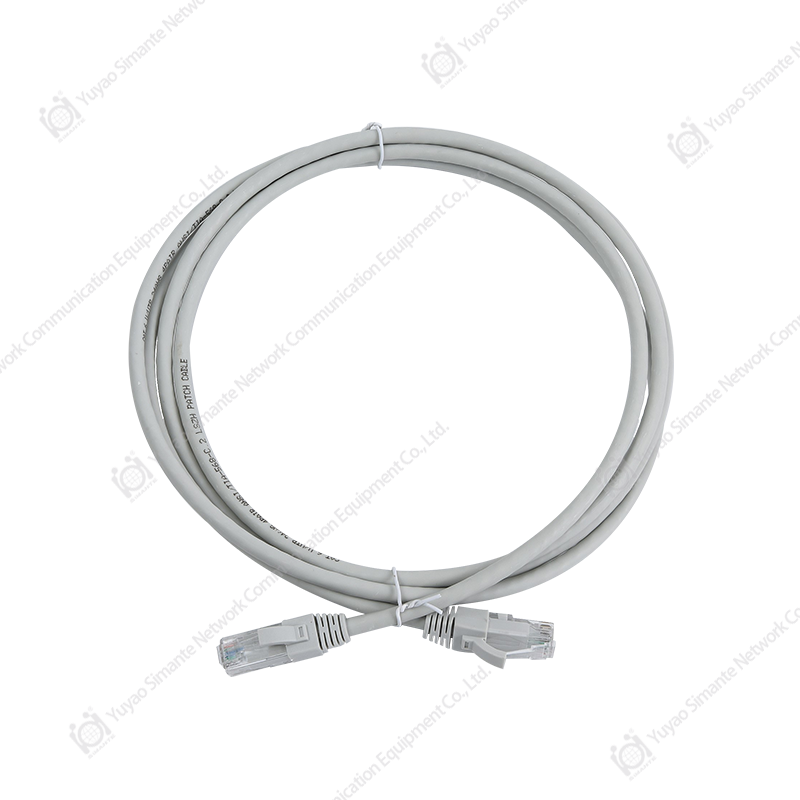 Patch Cord Manufacturing for OEM and Wholesale CablingExplore patch cord manufacturing for OEM and wholesale programs, including Cat.6A UTP/S/FTP and Cat.8 flat cable options, from a structured cabling supplier.View Product →
When we build patch cords for OEM and wholesale programmes, the variables that decide field life are the strand count, the copper grade, the contact plating thickness and the strain relief moulding. A cord that uses bare copper strands but a thin flash of plating will oxidise at the contact within a couple of years in a humid equipment room. The conductor is only half of the reliability equation, which is why a cord specification should list both.
Choosing by function, not by habit
- Horizontal runs, risers and backbones: solid bare copper, 22 to 24 AWG, to keep resistance and attenuation low.
- Patch cords and equipment leads: stranded bare copper, 24 to 28 AWG, short lengths, good strain relief.
- Patch panels and keystone terminations: designed for solid conductors, with IDC contacts sized to the conductor diameter.
- Reusable test leads and lab setups: stranded bare copper, because they are handled constantly.
Shielding Options Around a Bare Copper Core
Shielding does not replace copper, it protects the signal that copper carries. The common constructions are unshielded twisted pair, foil around the overall cable, foil around each pair with a braid overall, and combinations of the two. Each one changes how the cable behaves in an electromagnetic environment, and each one changes how the installer must terminate it.
- U/UTP. No shield. The simplest and cheapest construction, and the correct default for offices, schools and residential work where the electromagnetic environment is ordinary.
- F/UTP. One overall aluminium foil. Helps with high-frequency interference and reduces alien crosstalk between adjacent cables when the foil is bonded to a drain wire.
- S/FTP. Foil around each pair plus an overall braid. Strong protection against both interference and crosstalk, common in Cat6a and Cat7 designs, and the usual choice near motors, drives and radio equipment.
- SF/UTP. Overall foil plus overall braid without per-pair foils. A middle option that adds mechanical strength and improves shielding effectiveness at higher frequencies.
The critical installation rule is that a shield only works when it is grounded at both ends through a proper bonding path. An ungrounded shield behaves like an antenna and can make performance worse than an unshielded cable. This is why shielded systems demand shielded patch panels, shielded keystone modules, shielded cords and a documented equipotential bonding chain through the rack.
Termination quality dominates shielded system performance. A toolless keystone module that seats the foil correctly and clamps the drain wire to the housing will deliver the shielding effectiveness the cable was designed for. A module with a loose shield contact will pass a short link test and then fail a longer one under load. For buyers sourcing a complete channel rather than a single item, the sensible approach is to buy the panel, the module and the cord from the same manufacturer so that the impedance and the bonding geometry match.
A quick selection rule
If the site has no significant sources of interference, no long parallel runs beside power feeders and no requirement from the client's IT standard, unshielded bare copper cable is the right answer and will save both material and labour. Move to shielded construction when the cable route passes within a few tens of centimetres of variable frequency drives, when the client's standard demands it for 10G backbone, or when the environment is industrial, medical or broadcast.
Application Scenarios and Selection Points
Bare copper ethernet cable is specified across a wide range of projects, and the selection logic differs in each one. The following scenarios reflect the applications our own product lines serve, from structured cabling in commercial buildings to automation and connected homes.
Commercial structured cabling
Office floors, campuses and multi-tenant buildings remain the largest volume application. The usual pattern is Cat6 solid bare copper for horizontal runs, Cat6a or shielded Cat6a for the riser and backbone, and a matched set of panels, modules, faceplates and cords. The most common specification errors are under-specifying the riser, forgetting the bundle derating for PoE, and mixing brands inside one channel.
Data halls and high-density patching
In a data hall, cable density is high and airflow is limited. Bare copper conductors with low resistance produce less heat for the same PoE load, and shielded Cat6a keeps alien crosstalk under control when 48 cables share a one-unit panel. High-density patching also rewards good cable management, because a well-managed rack is easier to certify and much easier to service later.
Industrial and automation
Automation cells bring vibration, oil, temperature swings and electrical noise. Shielded bare copper cable with a robust jacket and a proper bonding scheme is the standard answer. Where cables flex repeatedly, stranded bare copper is used in the moving sections, with solid cable reserved for fixed runs.
Smart buildings and connected homes
Residential and light commercial installations frequently run voice, data, video and control over one cabling system. Cat6 solid bare copper supports 1G and 2.5G links comfortably and leaves room for future devices, and the port counts are usually small enough that using genuine copper costs very little in absolute terms.
Outdoor and harsh environments
For aerial, duct or direct burial routes, the conductor should still be bare copper; what changes is the jacket and the water-blocking construction. Gel-filled, PE-jacketed or armoured variants protect the copper, but they do not change the electrical characteristics. Be cautious with products marketed for outdoor use at unusually low prices, because the copper saving is often taken at the same time as the jacket upgrade.
What to specify in a selection note
- Category and required channel length, including the 10GBASE-T distance limit.
- Conductor material, gauge and construction, stated as solid bare copper with a nominal AWG figure.
- Shielding type, plus a statement of how the shield will be bonded.
- Jacket material and flame rating required by the local code.
- PoE class, expected current and maximum bundle size.
- Channel components, ideally from one manufacturer with a tested channel warranty.
- Acceptance testing method, sampling plan and the document the supplier must provide.
How to Verify Bare Copper Before You Accept a Shipment
Incoming inspection does not require a laboratory. It requires a plan, a few simple tools and a supplier who expects to be checked. For a container-level purchase, the checks below catch the overwhelming majority of conductor substitutions.
| Check | Method | What good looks like |
|---|---|---|
| Conductor material | Strip 30 cm, inspect the cross-section, weigh a 10 m sample | Uniform bright copper, no grey or silver core, weight consistent with copper density |
| Conductor resistance | Four-wire measurement, or the supplier's DCM report corrected to 20 degrees Celsius | Within the declared limit per 100 m and consistent reel to reel |
| Gauge | Cross-section photograph, laser gauge or calibrated micrometer | Nominal 23 AWG equals about 0.573 mm; 24 AWG about 0.511 mm |
| Length | Reel weight, length counter or time domain reflectometer | 305 m nominal, with a tolerance written into the contract |
| Link performance | Certification tester on a permanent link sample | Pass with reported margin, not simply a pass result |
| Jacket and print | Visual check, flame test certificate, UL file lookup | Legible print, correct flame rating for the installation space |
Reading a supplier test report
A useful report lists conductor resistance, mutual capacitance, characteristic impedance, attenuation at the category's key frequencies and return loss, with the measurement temperature recorded. It should name the standard the results are compared against. A report that only shows a category logo and a pass stamp tells you nothing about the conductor.
Questions that expose a weak supply chain
- Which copper grade is used, and is it oxygen-free or standard electrolytic copper?
- What is the measured loop resistance per 100 m at 20 degrees Celsius?
- Can the factory share a cross-section photograph or a metallurgical report for the current lot?
- Is the conductor single-piece drawn wire, or are shorter lengths welded together?
- Which test equipment is used for final inspection, and how often is it calibrated?
- What is the rejection rate for conductor-related defects over the last twelve months?
Two details deserve specific attention. First, welded joints in a conductor can raise resistance locally and create a mechanical weak point that snaps during pulling. Reputable manufacturers use continuous drawing and spooling. Second, jacket print quality is a surprisingly good proxy for plant discipline; smudged, misaligned or inconsistent print often correlates with other process problems further up the line.
Buying in Bulk from a Manufacturer, Not a Reseller
For a distributor, an integrator or a private-label brand, the sourcing decision usually comes down to whether the supplier controls drawing, insulation, twisting and jacketing under one roof. A manufacturer that controls the conductor has far less incentive to substitute it, and can usually explain exactly what changed when a lot behaves differently.
Yuyao Simante Network Communication Equipment Co., Ltd. is one such manufacturer, based in Yuyao, Zhejiang, producing copper and fibre structured cabling products since 2005, with more than 30,000 square metres of factory space, over 50 precision machines and exports to more than 45 countries. The wider product family, from modules and panels to faceplates and cable management, is documented in the copper system range, and a technical overview of how these pieces combine is available in the article on the core components of a structured cabling system.
Terms that protect a bulk buyer
- Conductor clause. State the material, the nominal gauge and the maximum resistance per 100 m, with a sampling plan and a rejection remedy.
- Sampling plan. For example, three reels per 500, measured on arrival at your warehouse, with retained samples for dispute resolution.
- Length tolerance. Define the acceptable shortfall per reel, and how shortfall is credited.
- Change control. Require written notice before any change to conductor supplier, insulation compound, jacket formulation or twist construction.
- Traceability. Lot code on the reel and on the carton, linked to an inspection record held by the factory.
- Packaging specification. Reel size, drum material, carton printing, pallet pattern and container loading, all agreed before the first shipment.
Customisation and OEM programmes
Private-label buyers usually need jacket printing, colour selection, reel labelling, custom lengths and retail packaging. Those requirements are straightforward for a factory with its own printing and jacketing lines, but they must be frozen before mass production, because changing print or length after the run starts creates waste that eventually appears in the unit price. Ask for a signed golden sample and keep it for the life of the programme.
Lead time and capacity planning
Copper prices move, and lead time follows raw material availability more than factory throughput. A supplier with stable drawing capacity and an established copper sourcing relationship can quote a firmer schedule. For annual contracts, agree a rolling forecast, a minimum order quantity per production run, and a delivery window rather than a single date.
Certification and compliance
Request the certificates that apply to the market you sell into, including flammability ratings, RoHS and REACH statements, and any third-party test reports for the exact construction you are buying. A certificate issued for a different construction is not evidence for yours, and that distinction matters in an audit.
Installation and Maintenance Practices That Protect the Copper
Even a perfect bare copper cable can be ruined by handling. The practices below come from field experience and from the installation requirements in the structured cabling standards.
Pulling tension and bend radius
The general limit for four-pair horizontal cable is around 110 newtons of pulling tension, and the minimum bend radius is roughly four times the cable diameter during installation and four times in the installed state for unshielded cable, with slightly larger figures for shielded constructions. Exceeding either limit stretches the conductor, changes the twist geometry and permanently raises attenuation. On a long pull, use a proper lubricant approved for the jacket material and pull by hand where possible.
Termination discipline
Untwist no more than 13 mm at a keystone module or patch panel, keep the pair geometry intact up to the contact, and seat the conductor fully. Re-terminating the same position more than twice can open the contact and raise resistance. On shielded modules, verify that the foil or drain wire is clamped to the housing rather than folded back under the jacket.
Cable management and heat
Bundle size affects temperature. A dense bundle carrying PoE current runs warmer than a sparse one, and the standard's derating factors assume the conductor is copper. Leave space between bundles, avoid trapping cables against ceiling voids or above light fittings, and use vertical and horizontal managers so that the bundle stays square rather than collapsed into a tight cylinder.
Documentation and test records
Record permanent link test results with margins, store the file against the project, and label both ends of every cable using a scheme that survives a decade. When a fault appears later, a labeled cable with a saved test file turns a two-hour investigation into a ten-minute one.
Routine maintenance
- Inspect patch cords annually for strain relief damage and replace rather than repair.
- Re-test a sample of high-power PoE channels each year, because thermal ageing shows up as rising attenuation.
- Clean and reseat connections in dusty industrial cabinets on a scheduled basis.
- Check that bonding conductors on shielded systems remain tight after any rack work.
- Keep a small stock of pre-tested spare cords so that a fault can be swapped rather than diagnosed under pressure.
Common Failure Modes and How to Diagnose Them
Most complaints about ethernet cable performance trace back to a small number of causes. Knowing which one produces which symptom shortens the diagnosis considerably.
- Elevated resistance along the whole run. Usually a clad or undersized conductor. A resistance measurement on a known length identifies it quickly.
- Single-pair failure. Almost always a termination problem: an untwisted section, a conductor not fully seated, or a damaged contact.
- Passing test with low margin. Frequently a long channel, an added patch cord beyond the planned length, or a conductor with more resistance than specified.
- Intermittent link under PoE load. Heat-related, and often amplified by a dense bundle or a CCA conductor. Compare behaviour at the start and end of the working day.
- Noise and errors in an industrial area. A shielding or bonding issue rather than a conductor issue. Check that the shield is grounded at both ends through the patch panel.
- Connector corrosion. Usually humidity plus thin plating, not a copper problem. Confirm plating thickness in the cord specification.
- Random failures after reconfiguration. Cable damaged during rack work, or reused patch cords beyond their service life.
A practical diagnostic sequence is to measure resistance first, then run a permanent link test with margin reporting, then inspect the terminations, and only then consider the active equipment. Starting at the electronics end wastes time far more often than it solves anything.
Frequently Asked Questions About Bare Copper Ethernet Cable
Is bare copper ethernet cable better than copper-clad aluminium?
Yes, for any permanently installed horizontal cabling. Solid bare copper has roughly 100 percent conductivity against about 60 percent for aluminium, which means lower resistance, less heat under PoE, less voltage drop at the powered device and more attenuation margin. CCA can be acceptable in short, low-power patch leads where the buyer understands the trade-off, but it is not a compliant horizontal cabling conductor.
How can I tell whether a cable is really bare copper?
Strip about 30 cm of jacket and insulation and look at the conductor cross-section. Genuine bare copper is uniform and bright across the full diameter, while a clad conductor shows a distinct core colour. Confirm with a resistance measurement on a known length and compare the result with the declared limit per 100 m.
Does bare copper ethernet cable support Power over Ethernet?
It is the conductor that PoE was designed around. Lower resistance means less energy lost as heat in the cable and more voltage available at the device. This matters most on long runs, at high power classes, and inside densely bundled cable trays where heat cannot escape.
What is the difference between bare copper and tinned copper?
The conductor is copper in both cases. Tinned copper carries a thin tin coating that resists oxidation, which is useful in humid, plenum and mildly corrosive environments. The cost is a small increase in resistance, typically two to four percent, and a slightly higher material price.
Can I mix Cat6 and Cat6a components in one channel?
Electrically you can, and the link will usually work. In practice, mixing brands and categories inside one channel makes the performance guarantee hard to enforce, because no single manufacturer will warrant the result. For projects with a channel warranty, buy the panel, module and cords as a matched set.
What gauge should I choose for a long PoE run?
For runs close to the 90 m permanent link limit, 23 AWG solid bare copper is the safer choice. It has lower resistance per metre than 24 AWG, so the voltage drop at the far end is smaller and the conductor runs cooler. Calculate the drop for your specific PoE class before you order.
How do I check the length of a reel I have received?
Weigh a full reel and compare it with the expected weight for the construction, or measure with a time domain reflectometer on a known good reel. A length counter at the factory is useful only if the counter is calibrated and the record is provided with the shipment.
Is Cat7 necessary if I already use Cat6a?
For most commercial and data hall work, Cat6a is sufficient and easier to terminate. Cat7 and Cat7a are ISO/IEC categories that appear mainly in industrial and high-interference environments, where per-pair shielding and a rigid bonding scheme deliver measurable benefits. Outside those cases the extra cost rarely returns value.
What should I test on arrival for a bulk order?
Sample conductor resistance, conductor cross-section, gauge, reel length, jacket print and flame rating, plus a permanent link certification on at least one full channel assembled from the delivered materials. Agree the sample size and the acceptance criteria in the contract so that both sides are working to the same number.
How long does bare copper ethernet cable last?
With correct installation and a suitable jacket for the environment, a solid bare copper channel is normally expected to serve for 20 to 25 years, which is the basis of most channel warranties. Clad conductors, damaged installations and extreme heat shorten that figure considerably.
Do you supply bare copper ethernet cable for wholesale and OEM programmes?
Yes. We manufacture copper and fibre structured cabling products, including patch cords, keystone modules, patch panels, faceplates, cable management and installation tools, and support custom lengths, jacket colours, printing and retail packaging for wholesale, distributor and private-label customers.
Where to Go Next
If you are specifying a project, start with the conductor clause and work outwards: gauge, category, shielding, jacket and PoE load. If you are sourcing for a distribution or private-label programme, start with the factory and the sampling plan, then agree packaging and change control. Either way, the copper inside the jacket is the parameter that decides whether the installation is still meeting its margin figure five years from now.
Explore the Smartyy range
As a manufacturer with more than three decades of accumulated production experience across the team, we work with integrators, wholesalers and brand owners who need consistent conductor quality, dependable lead times and a supplier who can answer a technical question with a measurement rather than an adjective.