Español
 عربى
عربى русский
Content
- 1 What Data Encoding Technology Is Used in Copper Cables? The Direct Answer
- 2 From Simple Pulses to Advanced Line Coding: The Main Encoding Technologies
- 3 Comparing the Encoding Technologies at a Glance: Signal Levels Matter
- 4 How the Encoding Technology Affects Real-World Copper Cabling Components
- 5 Copper Cable Categories and the Encoding Schemes They Support
- 6 Shielding, Noise, and the Practical Limits of Higher-Order Encoding
- 7 Selecting Copper Cabling Products for Your Encoding Requirements
- 8 Installation and Maintenance Practices That Preserve Encoding Performance
- 9 Frequently Asked Questions About Data Encoding in Copper Cables
- 9.1 What data encoding technology is used in copper cables?
- 9.2 Why is the answer "electrical impulses" rather than "pulses of light" for copper cables?
- 9.3 Does a higher-level encoding scheme always require a higher cable category?
- 9.4 Can I use Cat6 keystone jacks in a 10GBASE-T PAM-16 system?
- 9.5 What should a wholesaler ask a cabling manufacturer about encoding-related product quality?
- 10 Final Thoughts: Encoding Is the Bridge Between Speed and Cable Quality
If you have been searching for the exact question "what data encoding technology is used in copper cables," the short and correct answer is electrical impulses. Copper cables transmit binary data as controlled changes in voltage along the conductor, and the receiving equipment samples those voltage changes at precise intervals to rebuild the original 1s and 0s. This behavior is completely different from optical fiber, which carries data as pulses of light, and from wireless links, which modulate electromagnetic waves in free space. The encoding technology in a twisted-pair copper system is therefore an electrical signaling technology, and in modern Ethernet it has evolved far beyond simple on-off pulses. Understanding this evolution helps network engineers, IT buyers, and installation contractors choose the right cable category, connectors, and patch panels for a defined speed target.
The practical differences are easy to observe. 10BASE-T Ethernet sends one bit at a time using a two-level Manchester code; 1000BASE-T works on four pairs simultaneously with a five-level pulse amplitude modulation scheme called PAM-5; 10GBASE-T moves to a 16-level scheme known as PAM-16 with DSQ128 coding; and 25GBASE-T plus 40GBASE-T rely on PAM-4 inside Category 8 data center channels. The exact scheme decides how clean the entire transmission path must be, which is why a Cat5e link runs 1 Gbps comfortably but needs a lower-loss, lower-crosstalk channel before it can support 2.5GBASE-T or 5GBASE-T at full length. In the sections that follow, we first explain the direct answer, then compare the main encoding families, and finally translate the technical background into practical selection and procurement advice for copper structured cabling components. As a manufacturer of network cabling products, we also connect each encoding concept back to the components that make it work in the field.
The data encoding technology used in copper cables is electrical impulses, and the practical question for cabling buyers is which line code and voltage-level scheme your network speed requires.
What Data Encoding Technology Is Used in Copper Cables? The Direct Answer
The simplest form of copper data encoding is non-return-to-zero (NRZ) signaling. A transmitter holds the conductor at a high voltage for a logical 1 and at a low voltage for a logical 0, while the receiver samples the line at the clock rate to recover the bit stream. Long strings of identical bits make clock recovery difficult with plain NRZ, so Ethernet does not use it today, but the principle still explains the foundation: copper data encoding is always a matter of electrical impulses and voltage levels.
Twisted-pair Ethernet adds several layers of refinement on top of that foundation. Every link uses differential signaling: the two wires in a pair carry opposite voltages, and the receiver measures the difference between them, which cancels most common-mode noise. Line codes such as Manchester, MLT-3, and PAM pack more bits into each symbol and embed timing information directly into the signal. Finally, 1000BASE-T and faster standards transmit on all four pairs at once, so the answer to "what data encoding technology is used in copper cables" is best described as a multi-lane, multi-level electrical signaling system.
It is useful to place copper encoding next to the other two transmission media, because the comparison answers many certification questions and clarifies network design decisions.
| Transmission medium | Encoding mechanism | Structured cabling example |
|---|---|---|
| Copper twisted pair | Electrical impulses and voltage-level modulation | 1000BASE-T over Cat5e using PAM-5 |
| Optical fiber | Pulses of light in a glass or plastic core | 1000BASE-SX over multimode fiber |
| Radio / wireless | Modulation of electromagnetic wave amplitude or frequency | Wi-Fi channels using OFDM |
For copper cables, the practical conclusion is that every keystone jack, patch panel, patch cord, and faceplate in the link influences how faithfully those electrical impulses arrive. A connector with poor contact stability adds reflection, an over-untwisted pair adds crosstalk, and an underrated patch cord adds insertion loss. All of those impairments directly reduce the signal-to-noise margin that the encoding scheme needs at the receiver.
Copper data encoding is electrical impulse signaling; modern Ethernet uses multi-level schemes such as PAM to increase data rate without raising the symbol rate, and every passive component in the channel determines whether those impulses survive.
From Simple Pulses to Advanced Line Coding: The Main Encoding Technologies
When engineers ask what data encoding technology is used in copper cables, they usually want more than a one-line answer. In an Ethernet copper channel, the bit stream is first mapped to symbols by a line code, which defines how voltage levels, transitions, and timing represent bits. The line code determines the bandwidth of the signal and the signal-to-noise margin required at the receiver. Three families cover practically all twisted-pair Ethernet: Manchester coding, MLT-3, and pulse amplitude modulation (PAM). Outside LANs, DSL uses a different technique called discrete multi-tone (DMT), but structured cabling work is concerned with Manchester, MLT-3, and PAM.
Manchester Coding (10BASE-T)
Manchester coding represents a 0 as a low-to-high transition in the middle of each bit period and a 1 as a high-to-low transition. Because every bit contains a guaranteed transition, clock recovery is simple and reliable. The cost is efficiency: each bit occupies two signal states, so a 10 Mbps signal needs 20 million transitions per second and a broad bandwidth. Manchester was perfectly adequate for 10BASE-T in the 1990s, but it becomes impractical at 100 Mbps and beyond.
MLT-3 (100BASE-TX)
Fast Ethernet over Cat5 uses 4B5B block encoding followed by MLT-3, which stands for multi-level transmit with three levels. The three voltage states are positive, zero, and negative, and the signal cycles through them in sequence. MLT-3 lowers the fundamental frequency of the signal compared with a two-level code of the same data rate, which is why 100 Mbps works within the 100 MHz bandwidth of Cat5. It also demonstrates the general principle that adding levels buys more efficiency.
PAM-5 (1000BASE-T)
Gigabit Ethernet over twisted pair uses PAM-5, a pulse amplitude modulation scheme with five voltage levels on each of the four pairs. Four of the levels carry 2 bits per symbol, and the fifth level supports block coding for error detection. With 125 million symbols per second per pair and four pairs in parallel, PAM-5 delivers about 1 Gbps. PAM-5 needs a higher signal-to-noise ratio than Manchester or MLT-3, which is why full duplex gigabit requires correct termination on all four pairs and a channel tested to Cat5e or better.
PAM-4 (25GBASE-T and High-Speed Data Center Interfaces)
PAM-4 uses four voltage levels and carries 2 bits per symbol. It is the encoding chosen for 25GBASE-T on Category 8 copper, and it is also the dominant electrical interface inside data centers for 25G, 50G, 100G, and faster chip-to-chip and switch-to-switch links. Because the distance between adjacent levels is only one third of the full signal swing, PAM-4 is more sensitive to noise, insertion loss, and reflections than a two-level code. That sensitivity is why Category 8 channels are limited to 30 meters and normally use shielded connectors.
PAM-16 with DSQ128 (10GBASE-T and 40GBASE-T)
10GBASE-T and 40GBASE-T use a 16-level PAM scheme combined with a 128-double-square (DSQ128) constellation. The 16 voltage levels create 256 possible combinations of two symbols, but only 128 of them are valid, which keeps a larger distance between valid codewords and improves immunity to noise. Low-density parity-check (LDPC) error correction provides a second layer of protection. This is the most demanding encoding in current copper Ethernet standards, and it explains why 10GBASE-T requires Category 6A or Category 7 cabling for a full 100-meter channel, with Category 6 accepted only for shorter runs.
| Encoding scheme | Voltage levels | Bits per symbol | Typical standard | Data rate | Cable recommendation |
|---|---|---|---|---|---|
| Manchester | 2 | 0.5 | 10BASE-T | 10 Mbps | Cat3 or higher |
| MLT-3 with 4B5B | 3 | ~0.8 | 100BASE-TX | 100 Mbps | Cat5 |
| PAM-5 | 5 | 2 | 1000BASE-T | 1 Gbps | Cat5e |
| PAM-4 | 4 | 2 | 25GBASE-T | 25 Gbps | Cat8 up to 30 m |
| PAM-16 with DSQ128 | 16 | 3.5 | 10GBASE-T and 40GBASE-T | 10 or 40 Gbps | Cat6a, Cat7, Cat8 |
A clear pattern emerges from the table. As data rates rise, Ethernet uses more voltage levels instead of simply transmitting faster pulses. More levels mean more bits per symbol and a lower symbol rate, but the receiver must distinguish between much smaller voltage differences. The channel therefore has to deliver less noise and less distortion, which is why cable category, termination quality, and connector rating become the decisive factors at 10 Gbps and above.
Copper Ethernet encoding has moved from simple two-level transitions to multi-level PAM; every additional level increases the data rate per symbol but demands cleaner cable and better components.
Comparing the Encoding Technologies at a Glance: Signal Levels Matter
Encoding choices are easier to compare when we look at the number of voltage levels involved. Manchester works with only two levels and a transition in the middle of every bit period. MLT-3 raises the count to three so that 100 Mbps can share the same 100 MHz cabling band that once served 10 Mbps. PAM-based schemes go further, using four, five, or sixteen levels to carry multiple bits per symbol. The chart below shows those values side by side and explains at a glance why faster standards impose stricter requirements on cable quality.
At the left side of the chart, Manchester's two levels look simple and robust. A receiver only has to decide between two voltage states, so the noise margin is very wide. That is why 10BASE-T could run over ordinary telephone-grade cable with almost no special engineering. But the cost appears as bandwidth: two transitions per bit double the signaling rate. MLT-3, with three levels, lowers the fundamental frequency and made Fast Ethernet practical on existing Cat5. PAM-4 and PAM-5 both carry 2 bits per symbol, which is why they appear at very different speeds. PAM-5 handles 1 Gbps on four Cat5e pairs, while PAM-4 handles 25 Gbps on four Category 8 pairs. The levels are close enough that a small amount of crosstalk can move a sample into the wrong decision region. PAM-16 at the right side of the chart is the hardest case. Sixteen levels create fifteen boundaries between adjacent states, and noise must stay far below the voltage difference between them. In practice, 10GBASE-T protects those boundaries with DSQ128 coding and LDPC error correction. Even so, the physical channel must provide very low return loss, insertion loss, and alien crosstalk. That is exactly why the TIA and ISO cabling standards introduced alien crosstalk limits for Category 6A. It is also why a Cat6 link is certified for 10GBASE-T only up to 55 meters; beyond that distance, the noise margin of the PAM-16 signal is no longer guaranteed. For a cabling buyer, the conclusion is direct: the encoding scheme dictates both the cable category and the level of component quality you will need. A 1G PAM-5 system can tolerate ordinary Cat5e jacks and panels, while a 10G PAM-16 system cannot tolerate marginal components in any part of the link.
The more voltage levels an encoding scheme uses, the more demanding it is on cable and connector quality; selecting components without reference to the encoding technology is the most common cause of hidden network problems at 10G speeds.
How the Encoding Technology Affects Real-World Copper Cabling Components
Encoding is executed by the transceivers inside switches, network cards, and IP cameras, not by the passive cabling components themselves. A keystone jack does not know whether the signal is PAM-5 or PAM-16. However, every passive component in the physical channel either preserves or degrades the encoded waveform. If you want to build a network around a specific data encoding technology, you have to look at the components that carry those electrical impulses from one end of the link to the other.
Keystone Jacks and Information Outlets
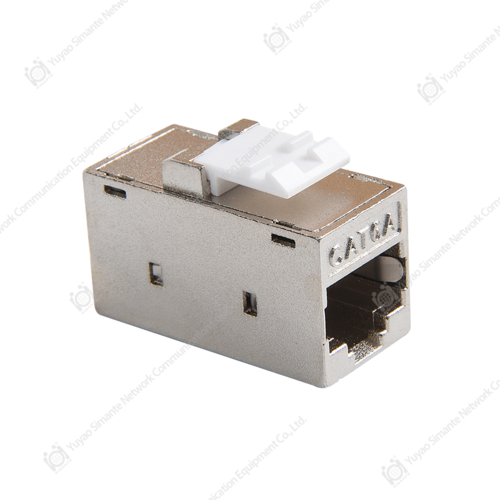
The keystone jack is the most critical point where the horizontal cable meets the equipment. Its IDC contacts must hold each conductor firmly, and its internal geometry must control return loss and near-end crosstalk at the frequencies used by the encoding scheme. A Category 6A keystone jack is designed to keep those parameters within limits up to 500 MHz, which covers the frequency content of the 10GBASE-T PAM-16 signal. Using a Cat5e jack on a Cat6a channel is a common mistake: the jack becomes the bottleneck, reflections appear, and the decoder at the switch has less margin. In shielded environments, jacks with a metal housing and a reliable ground connection also suppress the alien crosstalk that most threatens high-level PAM signals.
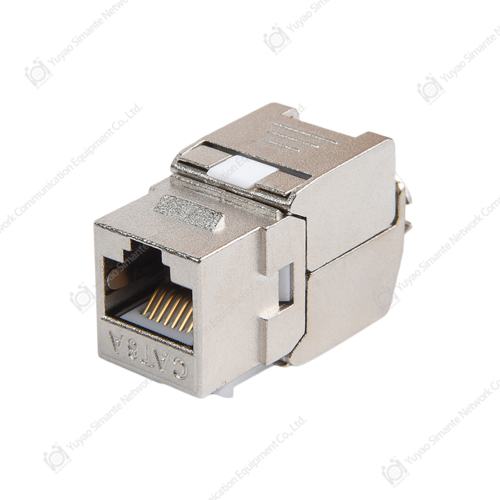
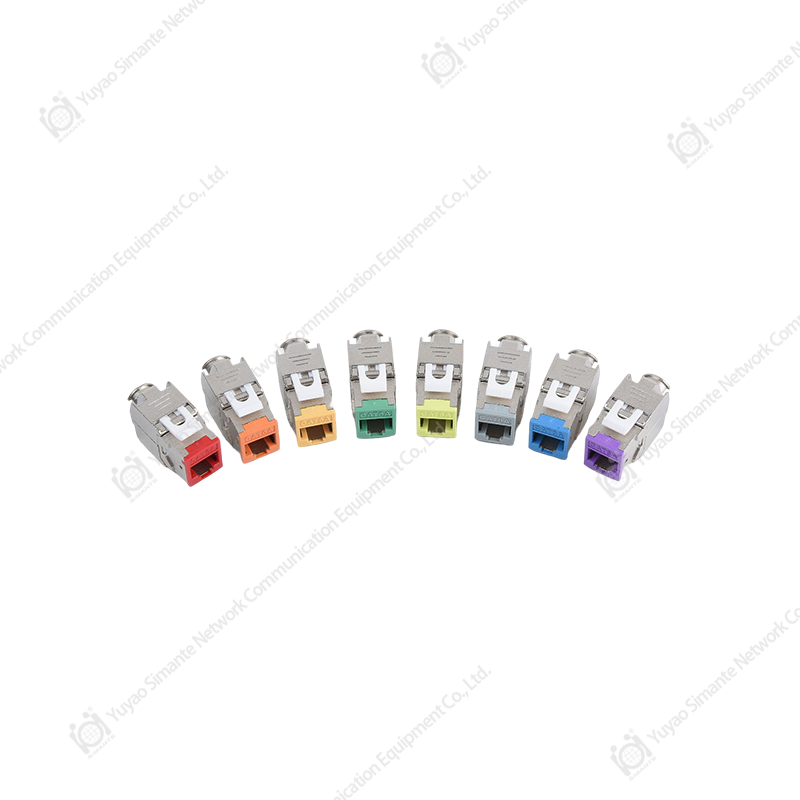 Shielded CAT6A Toolless Keystone Jack for 10GBASE-TThese keystone jacks maintain return loss and crosstalk up to 500 MHz, critical for PAM-16 encoding. Shielded models with metal housing suppress alien crosstalk, protecting signal integrity in industrial environments.View Product →
The faceplate or surface mount box around the jack has less influence on the electrical signal, but it still matters. A stable faceplate protects the termination from dust, vibration, and cable pulls. In industrial settings, a robust surface mount box prevents the small movements that gradually degrade contact pressure and shift the voltage levels of a high-order encoding.
Patch Panels and Patch Cords
In the wiring closet, the patch panel terminates the horizontal cables and provides the connection point to the switch. At high encoding levels, port density becomes a concern because adjacent ports are physically close and crosstalk between them can eat into the margin of a PAM-16 signal. Category 6A patch panels use internal compensation, and shielded models go further to minimize coupling between ports. The way cables are routed into the panel also matters, because tight bends and heavy bundles stress the pairs and increase crosstalk.
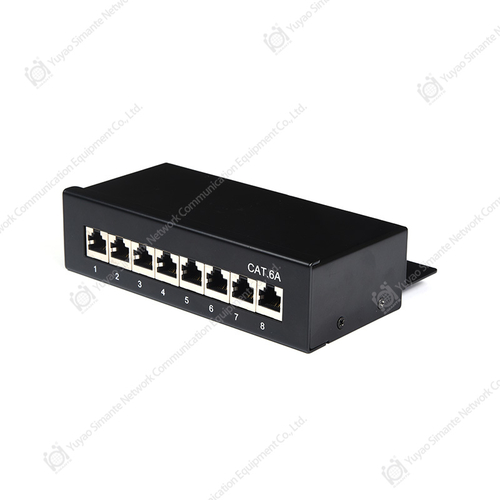 Shielded CAT6A Patch Panel for High-Density WiringThese panels use internal compensation and shielding to reduce port-to-port crosstalk, preserving PAM-16 margin. Available in 8, 12, and 24 ports, they support reliable 10GBASE-T channels in dense closet layouts.View Product →
The patch cord completes the channel, and it is the most frequently swapped component during troubleshooting. Many links that fail certification have a patch cord as the root cause: small conductor gauge, excessive untwisting at the plug, or a category rating below the rest of the channel. For 10GBASE-T, factory-terminated patch cords rated for the same category as the horizontal cable are strongly recommended. A damaged or mismatched patch cord is often the single largest reflection source in an otherwise well-designed link.
Related resources on smartyy.com:
The encoding scheme sets a performance budget for the whole channel; category-rated keystone jacks, patch panels, and patch cords are the components that spend that budget carefully, and they should come from one trusted supplier.
Copper Cable Categories and the Encoding Schemes They Support
The term cable category is best understood as a performance budget for the electrical impulses produced by the encoding scheme. Each category defines limits for frequency, insertion loss, return loss, and crosstalk. When the encoding uses more voltage levels and a wider frequency range, those limits have to become tighter.
| Category | Rated frequency | Encoding it supports | Maximum data rate | Typical channel |
|---|---|---|---|---|
| Cat5e | 100 MHz | PAM-5 for 1000BASE-T; 2.5GBASE-T with DSP-assisted signaling | 1 Gbps full; 2.5 Gbps upgrade | 100 m |
| Cat6 | 250 MHz | PAM-5 for 1000BASE-T; PAM-16 for short 10GBASE-T | 1 Gbps; 10 Gbps up to 55 m | 100 m or 55 m |
| Cat6a | 500 MHz | PAM-16 with DSQ128 for 10GBASE-T | 10 Gbps | 100 m |
| Cat7 | 600 MHz | PAM-16 with DSQ128 for 10GBASE-T | 10 Gbps | 100 m |
| Cat8 | 2000 MHz | PAM-4 for 25GBASE-T and 40GBASE-T | 25 or 40 Gbps | 30 m |
Two practical lessons follow. The first lesson is that 2.5GBASE-T and 5GBASE-T were intentionally designed to work over Cat5e and Cat6 channels, which gives existing installations a speed upgrade without re-cabling. The second is that 10GBASE-T over Cat6 is limited to 55 meters, and many installers overlook that limit until a link at 70 meters starts dropping frames. If a 10 Gbps channel has to reach the full 100 meters, Category 6A is the minimum, and every component in the channel must match that category.
There is also a future-proofing argument. The cost difference between Cat6 and Cat6a components is usually smaller than the labor cost of replacing horizontal cables later. A network that is 1G today but may move to 10G within a few years should be built with Cat6a jacks, panels, and patch cords from the start.
Cable categories are encoding budgets: choose the category that matches the fastest encoding you plan to run, and remember that 10GBASE-T over Cat6 is certified only for 55 meters, not for the traditional 100-meter office circuit.
Shielding, Noise, and the Practical Limits of Higher-Order Encoding
A multi-level PAM signal sends several bits in every symbol, which makes the voltage difference between adjacent levels smaller than it would be in a two-level code. Noise that was negligible at 100 Mbps can be enough to shift a sample into the wrong decision region at 10 Gbps. Electromagnetic interference from motors, power lines, and neighboring data cables appears at the receiver as added noise and crosstalk. As encoding levels rise, shielding becomes a real engineering decision rather than a cost option.
Two threats matter most in a copper network. Near-end crosstalk (NEXT) and return loss are controlled by connector quality and by preserving the twist of the pairs during termination. Alien crosstalk (AXT) comes from cables running in the same bundle and is the dominant external threat to 10GBASE-T channels. The most effective countermeasures are physical separation between bundles, or shielded cabling. The choice between unshielded and shielded components directly affects how much margin the encoding has at the receiver.
UTP (unshielded twisted pair)
|
STP / FTP (shielded twisted pair)
|
A common misunderstanding is that shielding changes the encoding itself. It does not. The modulation scheme is fixed by the Ethernet standard, and the shield only protects the already-modulated signal from interference. If a plant will carry PAM-16 over 100-meter channels and sits next to many other bundles, shielded Cat6a or Cat7 gives the decoder extra margin and measurably fewer errored frames. If the environment is quiet and the channels are short, UTP Cat6a remains a practical, lower-cost choice. The correct decision depends on the noise environment, the encoding level, and the expected link length.
Higher-order PAM encoding shrinks the voltage distance between symbols, so shielding and cable separation are practical ways to protect signal margin, not optional extras.
Selecting Copper Cabling Products for Your Encoding Requirements
Once you know which encoding technology your equipment uses, product selection becomes a systematic task. Start by defining the highest speed the network must support over the next three to five years. Then measure the channel distances, because a 100-meter path to a workstation is different from a 30-meter link inside a data center. Next, evaluate the electromagnetic environment: motors, HVAC drives, and high-density patch fields all reduce the margin of high-level PAM. Finally, confirm that the budget includes every component, because an unbalanced link performs at the level of its weakest part.
The four profiles below describe common combinations of encoding technology, cable category, and product type. They provide a practical starting point for integrators, wholesalers, and facility managers who need a repeatable specification.
Home and small office
1G PAM-5 over Cat5e or Cat6; an upgrade path to 2.5GBASE-T; keystone jacks, one- or two-port faceplates, and a basic patch panel.
Enterprise offices
1G today with 10GBASE-T PAM-16 readiness; Cat6a jacks and patch panels; cable managers to keep patch fields short and tidy.
Data center
25G or 40G PAM-4 over Cat8; shielded patch cords; high-density panels with clear cable routing and airflow.
Industrial and outdoor
Shielded Cat6a for high-EMI areas; surface mount boxes and heavy-duty faceplates; short patch cords to limit exposure.
When you buy from a manufacturer, supplier, or wholesaler, ask for the measured performance data behind the category label. A credible manufacturer can provide insertion loss, return loss, and crosstalk test results for keystone jacks and patch panels, and can confirm that the parts are compatible with the encoding your network will use. For wholesalers serving installation contractors, the availability of matching faceplates, surface mount boxes, cable managers, and patch cords often determines whether a 10G job passes certification on the first attempt.
As a structured cabling manufacturer with nearly twenty years of production experience, we have seen many projects where the cable itself was excellent but a keystone jack or a patch cord was the weak link. Sourcing the full channel path from the same manufacturer reduces compatibility risk, especially for high-level PAM signals where every millivolt of margin counts. Custom requirements such as specific colors, labeling, or port configurations can also be handled through wholesale and OEM programs without changing the electrical performance of the products.
Match the cable category and every passive component to the highest-speed encoding your network will run; a balanced channel from one manufacturer is the most reliable way to protect PAM signal margin.
Installation and Maintenance Practices That Preserve Encoding Performance
An encoding scheme performs only as well as the termination that carries it. A PAM-16 signal with sixteen voltage levels leaves almost no room for a sloppy RJ45 termination. The practices below protect signal quality from the wiring closet to the workstation outlet.
- Keep the untwist length at the termination as short as possible; more than 12 or 13 mm of untwisted pairs measurably raises near-end crosstalk and return loss.
- Use the correct IDC tool and seating force for keystone jacks and patch panels; a half-seated wire ruins contact resistance.
- Maintain a bend radius of at least four times the cable diameter, especially near patch panels and outlets.
- Use cable managers to secure vertical and horizontal bundles; gravity and sharp bends stretch pairs and change impedance.
- Do not over-tighten cable ties; deformation of the jacket changes the twist geometry and increases crosstalk.
- Test every link after termination with a field tester that measures return loss, near-end crosstalk, and insertion loss against the category limits.
- Label both ends of each link so that future troubleshooting does not disturb working channels.
- Keep patch cords tidy and replace any cord with a damaged latch or visible kink; a marginal patch cord is the most common hidden source of reflective noise.
Maintenance matters just as much as the original installation. When the patch field density changes, when new cables are added to the same tray, or when dust settles on contacts, the performance of a high-level PAM channel can drift. Periodic re-testing of critical 10G and 25G links, together with cleaning of rarely touched connectors, keeps the encoding margin stable over years of operation.
For distributors and installers, spare patch cords and surface mount boxes are inexpensive insurance. If a link fails certification, a known-good replacement cord often identifies the fault in minutes. An easily replaceable surface mount box avoids cutting into drywall when a socket has to be changed. Because our factory produces these consumables in volume, wholesalers can bundle them with standard panels and jacks at predictable cost.
Termination discipline, bend-radius control, and orderly cable management preserve the voltage-level spacing that advanced copper encoding depends on; re-testing after any change keeps the margin verifiable.
Frequently Asked Questions About Data Encoding in Copper Cables
What data encoding technology is used in copper cables?
Copper cables use electrical impulses as the fundamental transmission mechanism. Binary data is represented by voltage levels on twisted pairs, and modern Ethernet adds line coding such as Manchester, MLT-3, PAM-5, PAM-4, and PAM-16 with DSQ128 to carry more bits per symbol. The exact technology depends on the speed standard: 1G Ethernet uses PAM-5, 10GBASE-T uses PAM-16 with DSQ128 and LDPC error correction, and 25GBASE-T uses PAM-4 over Category 8 cabling.
Why is the answer "electrical impulses" rather than "pulses of light" for copper cables?
Because the physical medium is a metallic conductor. Copper cannot carry light, so the signal takes the form of varying voltage and current. Optical fiber carries pulses of light, which is why fiber-based encoding is described differently. The two technologies complement each other in a typical building: copper handles cost-sensitive links up to 100 meters, while fiber covers longer distances and significantly higher bandwidth.
Does a higher-level encoding scheme always require a higher cable category?
In most cases, yes. PAM-5 works on Cat5e, PAM-16 with DSQ128 requires Cat6a for 100-meter 10GBASE-T channels, and PAM-4 for 25GBASE-T is specified on Category 8 cable limited to 30 meters. The reason is noise margin: more voltage levels mean smaller distances between adjacent levels, so the cable must reduce crosstalk and loss. There are exceptions, such as 2.5GBASE-T, which uses advanced DSP to deliver higher data rates over Cat5e and Cat6 links.
Can I use Cat6 keystone jacks in a 10GBASE-T PAM-16 system?
You can, but only when every link is shorter than 55 meters and the entire channel meets Cat6 limits, including alien crosstalk. In a dense cable environment, the safer practice is to standardize on Cat6a jacks and patch panels, because they are individually tested to 500 MHz and specified for alien crosstalk. When you order from a manufacturer or wholesaler, request the category test reports before committing to large quantities.
Ask four questions. Whether the keystone jacks and patch panels are tested for return loss and near-end crosstalk at the full category frequency. Whether the patch cords are factory terminated and channel-matched to the jacks. Whether shielded products have documented grounding and alien crosstalk performance. And whether the manufacturer supports OEM specifications such as custom colors, labeling, and packaging. A manufacturer that answers these questions with measured data is far more likely to deliver components that preserve the margin of high-level PAM encoding.
Confirm the encoding standard first, match the cable category and component ratings to it, and request measured test data from the manufacturer before placing a wholesale order.
Final Thoughts: Encoding Is the Bridge Between Speed and Cable Quality
The question what data encoding technology is used in copper cables now has a complete answer: electrical impulses, refined by line codes that evolved from Manchester to MLT-3 and then to the PAM family. The engineering trend is consistent across every Ethernet generation. Whenever the data rate doubles, the encoding either adds voltage levels or improves the modulation efficiency, and the cabling system must become electrically cleaner to support it.
For network owners and contractors, the translation is simple. Determine the fastest encoding you will run during the expected life of the installation, then specify the cable category and channel components accordingly. A Cat6a channel with properly rated jacks, panels, and cords gives clean margin for 10GBASE-T. A Category 8 shielded channel does the same for 25G and 40G PAM-4 links. The price difference between a marginal link and a robust link is small compared with the cost of downtime and re-cabling later.
When you source components, work with a manufacturer or supplier that can document performance and supports the complete copper system, including faceplates, keystone modules, patch panels, cable managers, and patch cords, under one quality system. That is the simplest way to guarantee that the encoding technology at the switch sees a channel built to preserve it. In copper networks, data encoding is electrical by nature and increasingly multilevel by design. The job of the cabling industry, from the factory floor to the final termination, is to make those small voltage changes arrive exactly where they are needed.
Copper data encoding began with simple electrical impulses and evolved into multi-level PAM; the physical layer determines whether the encoding survives, so category selection and component quality are inseparable from network speed.