Español
 عربى
عربى русский
Content
Choosing the right size patch panels depends primarily on rack space, port density requirements, and future expansion plans. Standard sizes are usually measured in "U" (rack unit), with the most common being a 1U 24-port patch panel or a 2U 48-port patch panel. When selecting a patch panel, first, calculate the total number of data points expected in the current and next two years, ensuring a 20% redundancy margin. Second, confirm that the rack depth and width are compatible with the network patch panel. Finally, select the appropriate cable management space based on the cable type (e.g., Cat6 or Cat6A) to achieve efficient data center cabling management.
Understanding the Core Role of Patch Panels in Network Architecture
In modern data centers and enterprise LANs, patch panels are not only physical connection aggregation points but also the cornerstone of network flexibility. They significantly reduce maintenance difficulty by decoupling horizontal cabling from switching equipment.
- Aesthetically pleasing cable management: Avoids a "spider web" effect inside the rack.
- Equipment protection: Reduces hardware damage caused by frequent plugging and unplugging of switch ports.
- Clear Logic: Works with a tag management system to quickly pinpoint network fault locations.
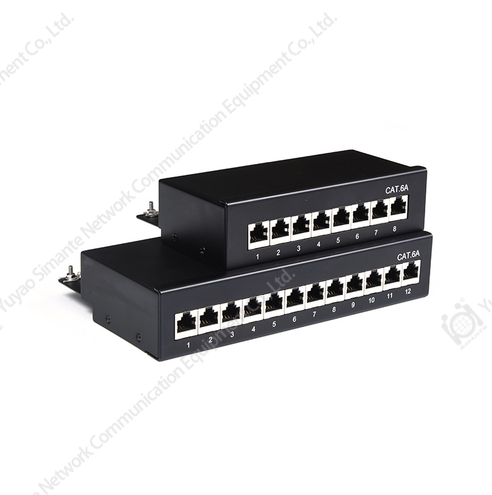
Three Key Dimensions for Choosing Patch Panel Size
1. Port Density and Space Utilization
Physical dimensions directly affect the rack's capacity.
1U Height: Suitable for small to medium-sized offices or edge computing nodes, typically providing 24 ports. If rack height is limited, high-density (e.g., 1U 48-port) shielded patch panels are a better choice.
2U and Above: Suitable for core server rooms, facilitating larger-scale cable bundling and distribution at the back.
2. Cable Standards and Physical Compatibility
Patch panel dimensions include not only the front width but also the depth of the rear cable management rack.
Cat6A Requirements: Due to the thicker thickness and larger bending radius of Cat6A cables, it is recommended to choose a model with a rear cable management rack. This will occupy more depth space but ensures signal transmission is not affected by physical compression.
Modular vs. Fixed: Modular patch panels allow for mixed installation of fiber optic and copper cabling, offering greater size flexibility.
3. Redundancy and Future Expandability
A professional network plan shouldn't be limited to immediate needs.
Spare Ratio: When determining network patch panel size, it's recommended to calculate total port requirements using the formula "Actual number of ports ÷ 0.8".
Heat Dissipation Space: Dense cabling can obstruct airflow. In high-density deployments, adequate blank panels should be reserved between patch panels to optimize heat dissipation.
Patch Panel Selection Guide
To help you make a quick decision, here are scenario-based patch panel selection strategies:
| Scenario Types | Recommended number of ports: | Recommended Sizes: | Key considerations: |
| Small Home/Office | 12 - 24 ports | 1U or Wall-mounted | Space saving and ease of installation. |
| Medium-sized Enterprise Branch | 48 - 96 ports | 1U High-density | Strong and weak current interference shielding (select shielded type). |
| Large Data Center | 500 ports or more | 2U/4U Modular | High maintenance frequency; requires support for hot-swapping and rapid tagging. |
Professional Advice for Optimizing Cabling Performance
Choosing the right size is only the first step. To maximize patch panel performance, pay attention to the following details:
Matching Cable Managers: Horizontal cable managers should match the patch panel ratio. It's generally recommended to have 1U of cable manager per 1U patch panel to ensure smooth cable bending and reduce return loss.
Color Coding and Labeling: Use different colored patch panel modules to distinguish between internal networks, external networks, and voice signals. A clear labeling system can reduce troubleshooting time by more than 50%.
Shielding and Grounding: If a shielded patch panel is selected, ensure that its built-in grounding busbar is connected to the rack's grounding system; otherwise, its anti-interference performance will be significantly reduced.
Size selection is essentially a balance between "current cost" and "future maintenance difficulty." Patch panels that are too small will increase the pain of cable management later, while blindly pursuing oversized panels will waste expensive rack space.